What is frequency analysis, and how does it break the Caesar cipher?
Frequency analysis exploits the fact that in any language, certain letters appear more often — so the most frequent letter in ciphertext likely corresponds to the most common letter in the language.
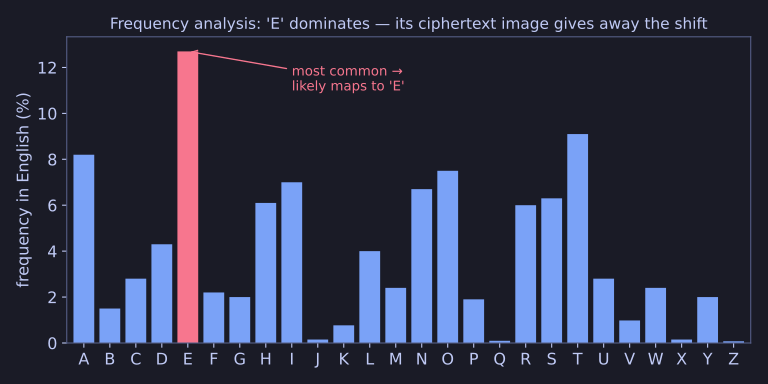
* Letter frequencies survive a monoalphabetic cipher and give away the key. *
How it works against Caesar:
- Count the frequency of each letter in the ciphertext
- The most frequent ciphertext letter probably maps to the most common plaintext letter (e.g., 'E' in English, 'E' in German)
- The difference between these two letters reveals the shift key
Example: If 'H' is the most frequent letter in the ciphertext and 'E' is the most common letter in the language, the shift is $H - E = 3$.
Why this is devastating for monoalphabetic ciphers:
- Every instance of 'E' always maps to the same ciphertext letter
- With enough ciphertext, the frequency distribution of the original language shines through
- This works not just for Caesar but for any monoalphabetic substitution cipher
Why it fails against Vigenère: In a polyalphabetic cipher, 'E' maps to different ciphertext letters depending on position, which flattens the frequency distribution and hides the pattern.
Go deeper:
 Frequency analysis - how characteristic letter frequencies break monoalphabetic and Caesar ciphers.
 dCode Frequency Analysis - paste ciphertext and get letter/bigram/trigram counts against reference tables.