Quiz Entry - updated: 2026.07.30
What is HSRP preemption, and what happens without it when a higher-priority router comes online?
Without preemption, a router that becomes active stays active even if a higher-priority router later joins. With preemption enabled (standby preempt), the higher-priority router will force a new HSRP (Hot Standby Router Protocol) election and take over.
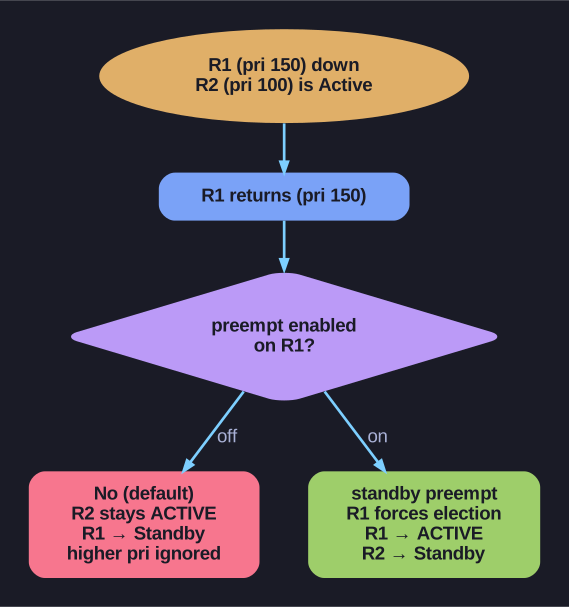
* How preemption decides reclaiming active. *
Without preemption (default behavior):
- R1 (priority 150) is down for maintenance
- R2 (priority 100) becomes active — it's the only router
- R1 comes back online with priority 150
- R2 remains active — R1 becomes standby despite having higher priority
- R1 will only become active if R2 fails
With preemption enabled on R1:
- Same scenario — R2 is currently active
- R1 comes online with priority 150 and has
standby preemptconfigured - R1 forces a new election and takes over as active
- R2 transitions to standby
Preemption rules:
- Only works based on priority — a higher priority triggers preemption
- A router with equal priority but higher IP (Internet Protocol) will NOT preempt (priority must be strictly higher)
- Both routers should have preemption enabled for predictable behavior
- Preemption is disabled by default — you must explicitly enable it
When to use preemption:
- You have a preferred primary router (e.g., the one with the faster WAN uplink)
- You want the primary to automatically resume the active role after recovery
- Without preemption, you'd need to manually fail back by shutting down the current active
Tip: A common scenario: "R1 has priority 150 but R2 is active. Why?" — Answer: Preemption is not enabled, and R2 became active first.
Go deeper:
 Virtual Router Redundancy Protocol (Wikipedia) — preemption behaviour (a higher-priority router pre-empting the master), the open-standard analogue.