What is inter-VLAN routing, and what are the three methods to implement it?
Inter-VLAN routing is the process of forwarding network traffic from one VLAN (Virtual Local Area Network) to another, and the three methods are legacy (multi-interface), router-on-a-stick, and Layer 3 switching with SVIs (Switch Virtual Interfaces).
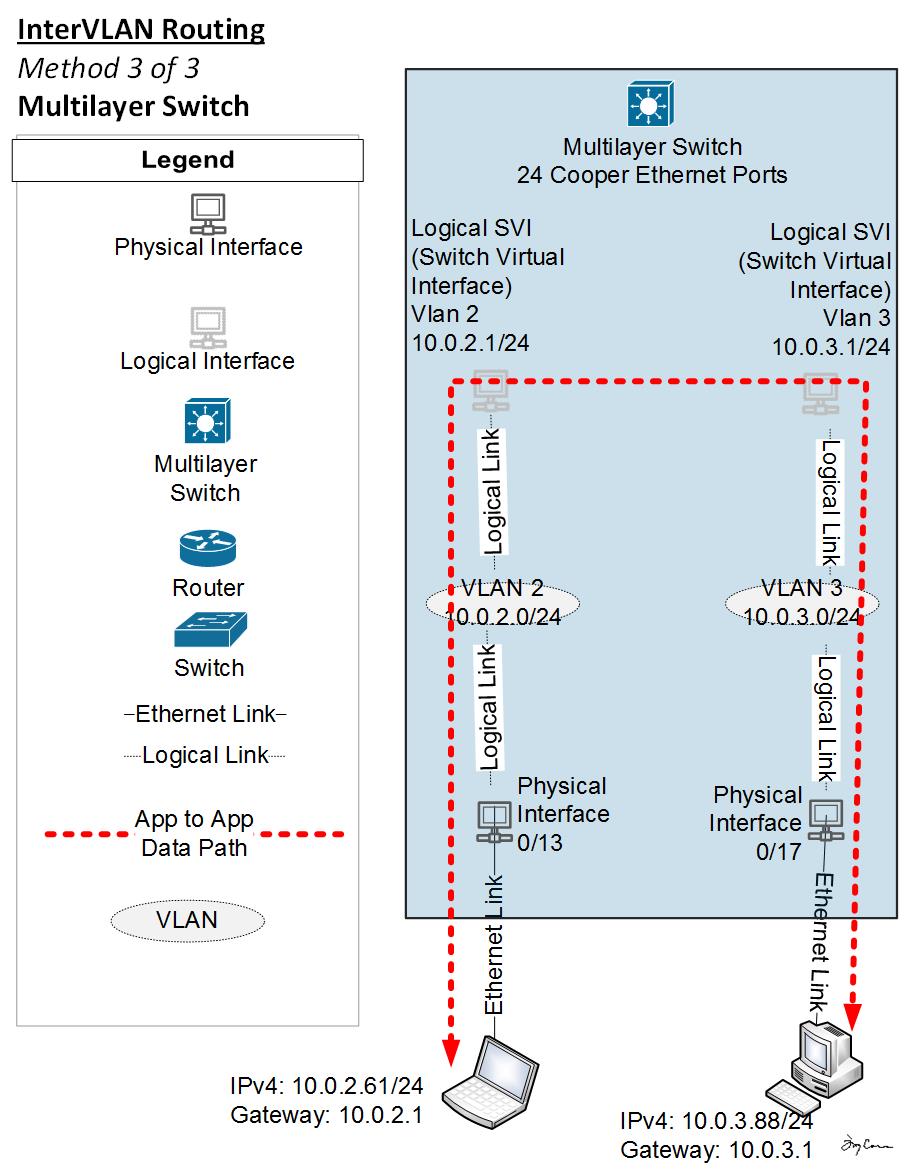
* A Layer 3 switch routing between VLANs. — Engineertcarman, CC BY-SA 4.0, via Wikimedia Commons. *
Because VLANs segment a network at Layer 2, hosts in different VLANs cannot communicate without a Layer 3 device to route between them — even if they're on the same physical switch.
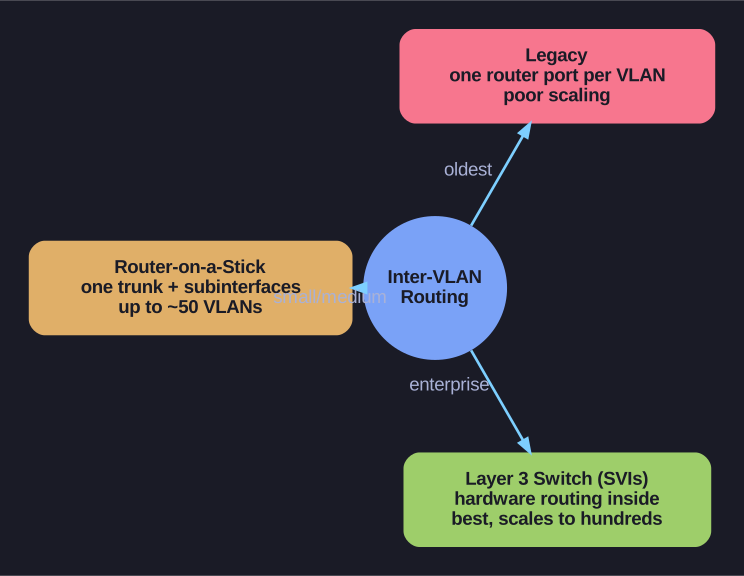
* The three methods at a glance — from least to most scalable. *
| Method | Description | Scalability |
|---|---|---|
| Legacy | One physical router interface per VLAN | Poor — limited by physical ports |
| Router-on-a-Stick | One physical link with subinterfaces | Medium — up to ~50 VLANs |
| Layer 3 Switch (SVIs) | Switch with built-in routing via virtual interfaces | Best — enterprise-grade |
Tip: Think of it as evolution — legacy was the first attempt, router-on-a-stick was the clever workaround, and Layer 3 switches are the modern solution.
Go deeper:
 Routing Between VLANs & Layer 3 Switches (PracticalNetworking) — walks all three methods (separate physical interfaces, router-on-a-stick, L3 switch/SVI) side by side with topology diagrams.