What is mmWave, why was it barely used in telecom before, and how does 5G split the spectrum into low/mid/high bands?
mmWave is radio in the ~30–300 GHz range; it promises far higher speeds but has short range due to high attenuation, which kept it out of telecom until now. 5G distinguishes low (600–850 MHz), mid (2.5–3.7 GHz), and high (25–39 GHz) bands, each trading speed against coverage.
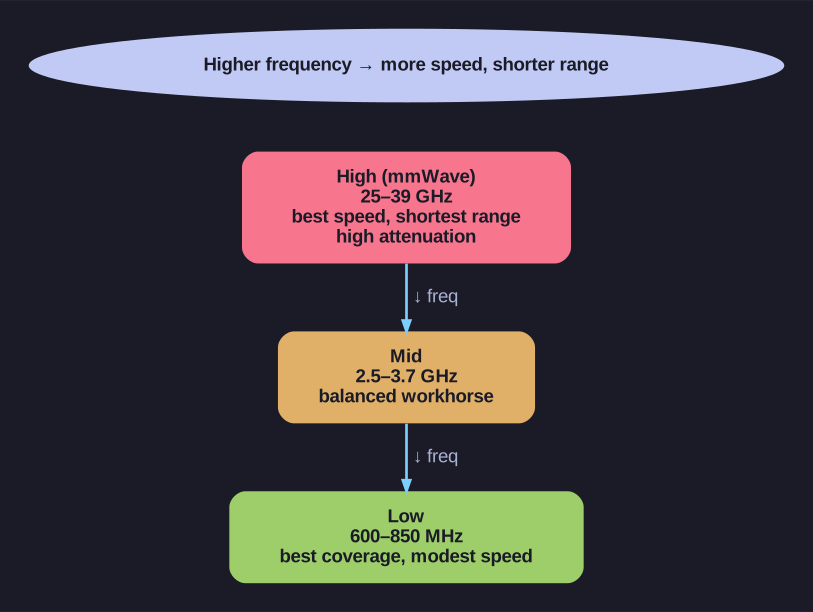
* 5G's low/mid/high spectrum tiers trade speed against range. *
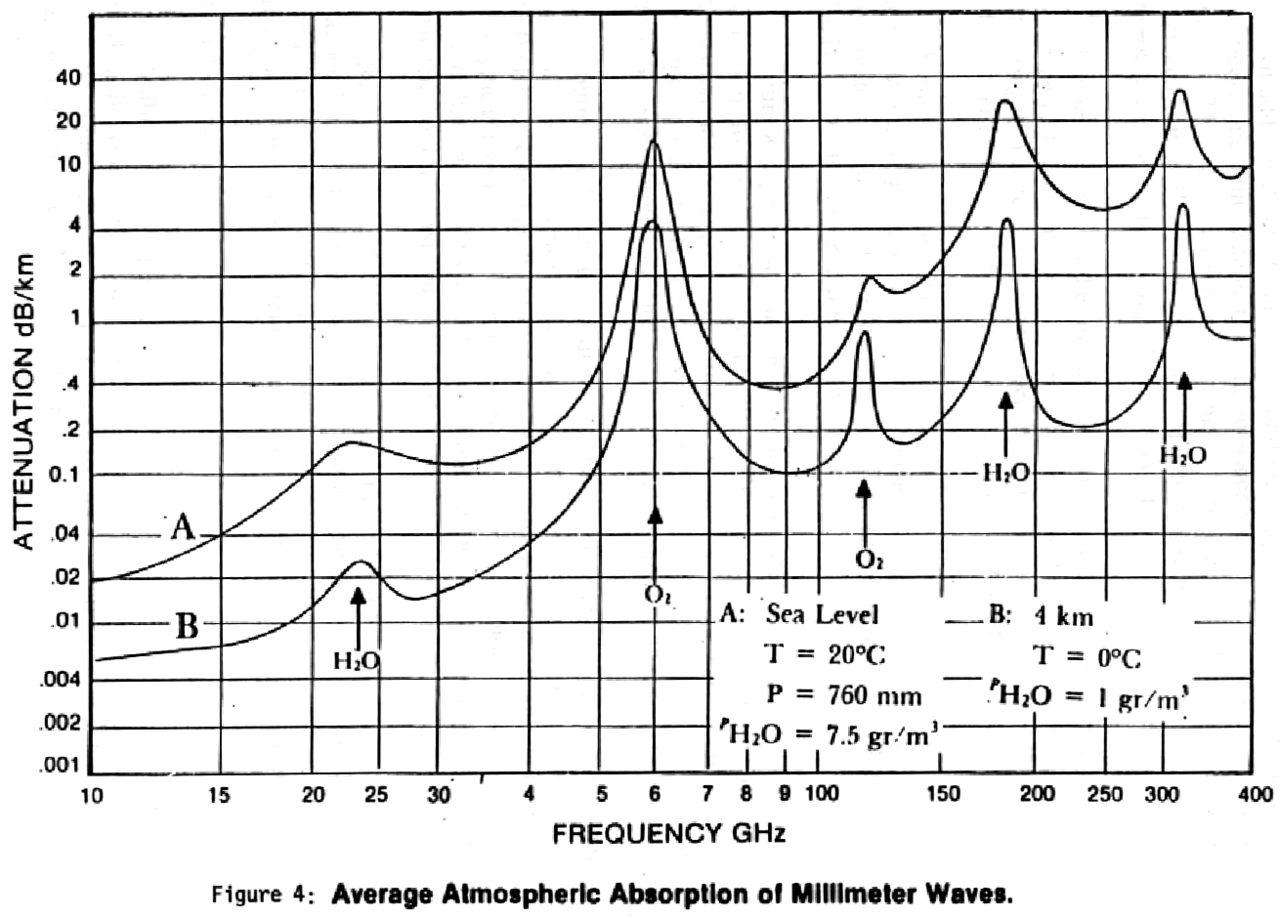
* Atmospheric absorption rises across the mmWave band. — FCC OET, Public domain, via Wikimedia Commons. *
mmWave (millimetre wave):
- Radio frequencies between roughly 30 and 300 GHz
- First studied at the end of the 19th century — long known, rarely used in telecom
- Promises incomparably better transmission speeds, but has short range because of high attenuation (it loses strength when absorbed by air or moisture)
The negative frequency–range relationship: the higher the frequency, the shorter the range. So 5G uses three spectrum tiers:
| Tier | Frequency | Trade-off |
|---|---|---|
| Low | 600–850 MHz | best coverage, modest speed |
| Mid | 2.5–3.7 GHz | balanced |
| High | 25–39 GHz (mmWave) | best speed, shortest range |
The practical upshot: higher bands offer better speeds but at the cost of lower range. Operators deploy a mix: low band for wide/rural and indoor coverage, mid band as the workhorse, mmWave for dense hotspots (stadiums, city centres) where capacity matters more than reach.
Tip: mmWave's century-old physics didn't change — what changed is that we now need its bandwidth badly enough to build the dense small-cell networks required to use it.
Go deeper:
 5G mmWave: Millimetre Wave (Electronics Notes) — the telecom angle: why mmWave was avoided (no wall penetration, rain attenuation), the ~200–300 m practical range, and how beamforming makes it usable for dense small cells.
- Extremely high frequency (Wikipedia) — the 30–300 GHz mmWave band, why atmospheric absorption rises sharply with frequency, and hence why range collapses (and the carousel's diagram source).
- Mobile communications: evolution towards 5G (BAKOM/OFCOM) — how Switzerland actually carved up this spectrum: the 2019 auction of 700 MHz / 1400 MHz / 3500 MHz bands and what each is used for in the live Swiss network.