What is MTU and how does it relate to IP fragmentation?
MTU is the largest payload a data link can carry; when a packet exceeds it, IPv4 fragments the packet into smaller pieces (IPv6 does not — the source must size it correctly).
The Maximum Transmission Unit (MTU) exists because each medium has a physical limit on frame size — Ethernet's is 1500 bytes, while some WAN links are smaller. The Data Link Layer tells the Network Layer this limit. When an IPv4 packet is larger than the outgoing link's MTU, the router must fragment it: split the single packet into several smaller packets that each fit, to be reassembled at the destination. This is undesirable because it adds processing work and latency, and a single lost fragment forces the whole original packet to be discarded. IPv6 removes this burden from routers entirely — they never fragment; instead the sending host is responsible for discovering the smallest MTU on the path (Path MTU Discovery) and sizing its packets to fit before transmitting.
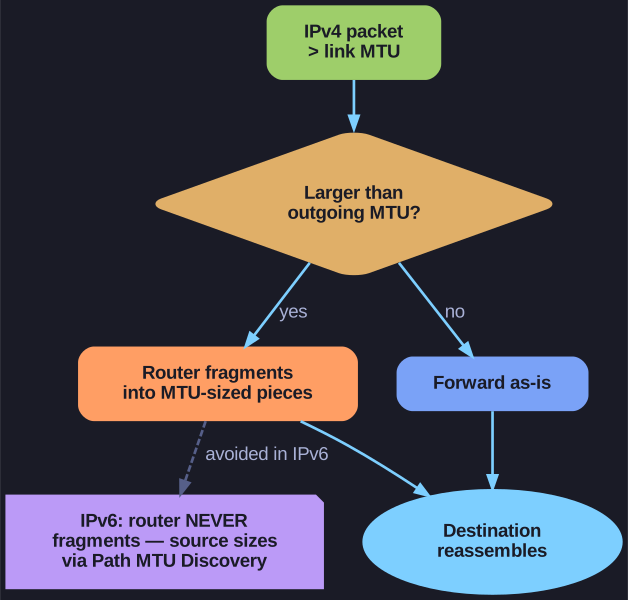
* IPv4 routers fragment packets larger than the link MTU; IPv6 pushes sizing to the source via Path MTU Discovery. *
MTU (Maximum Transmission Unit):
- The maximum size of data the Data Link Layer will accept
- Established by control information from the Data Link Layer
Fragmentation:
- When a packet is larger than the MTU, Layer 3 must split the IPv4 packet into smaller units
- Fragmenting causes latency (delay)
- IPv6 does NOT fragment packets - the source must adjust packet size
Example scenario:
- Router receives packet from Ethernet (MTU 1500 bytes)
- Needs to forward to a slow WAN link with smaller MTU
- Router must fragment the packet
Context: Fragmentation is undesirable because it increases processing overhead and latency. Path MTU Discovery helps avoid fragmentation by finding the smallest MTU along the path.
Go deeper:
 Wikipedia — IP fragmentation — how fragments are split, reassembled, and why IPv6 routers never fragment.
- Wikipedia — Maximum transmission unit — what MTU is and the latency trade-off behind it.