What is predictive policing, and on which three criminological theories does it rest?
The use of algorithms and big data on past crime data to predict where and when crime is most likely, so that patrols can be sent there. It rests on the broken windows theory, the routine activity approach and the near-repeat victimisation phenomenon.
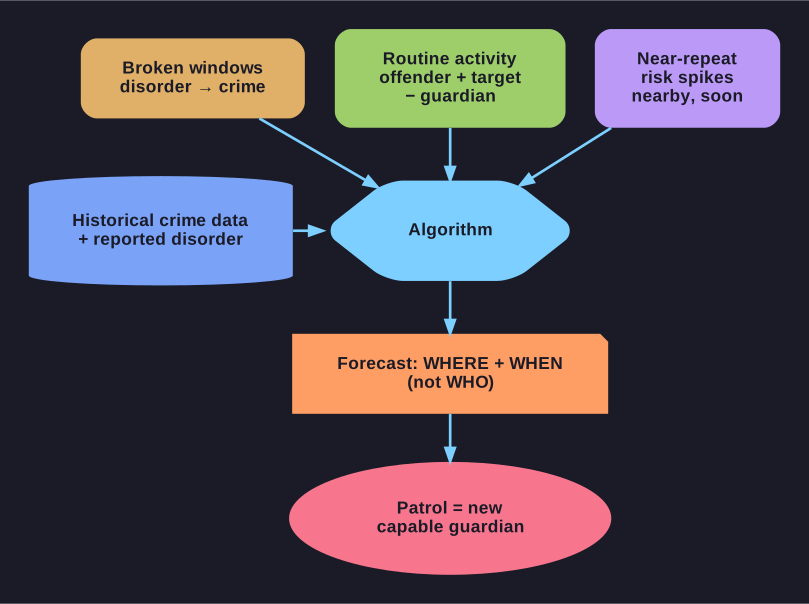
* Predictive policing turns three criminological theories into a forecast of places and times, not people *
Predictive policing systems analyse historical crime data, social factors or reported disorder to calculate where and when crimes are most likely. Most systems forecast places and times (hot spots), not individual offenders, and the police use the forecast to direct limited patrol resources.
The software does not discover new knowledge on its own. It turns three social-science theories into algorithms:
- Broken windows theory: disorder that is left alone attracts more crime.
- Routine activity approach: crime happens where a motivated offender, a suitable target and the absence of a capable guardian meet.
- Near-repeat victimisation: after a successful crime, the risk rises for a short time in the immediate neighbourhood.
Each has its own card. The ethical questions follow from this: the forecasts are only as good as the theories and the historical data, and data that reflect past police practice can send patrols back to the same neighbourhoods again and again.
Go deeper:
 Egbert (2017): Siegeszug der Algorithmen? Predictive Policing im deutschsprachigen Raum — methods, effectiveness and data bias in German-speaking countries (German).
- Wikipedia: Predictive policing — overview and criticism.