What is "pseudonymity" as a property, and what everyday examples illustrate it?
Pseudonymity is the state of being referred to by a pseudonym — an identifier that is not your real name — such that an attacker cannot sufficiently infer your true identity from it.
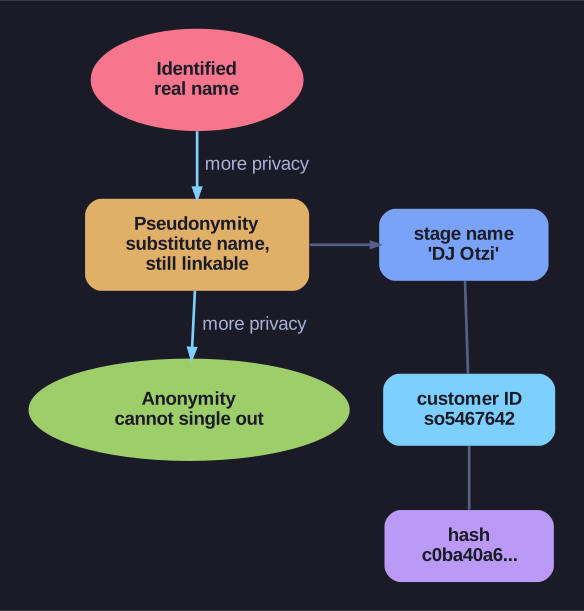
* Pseudonymity sits between full identification and anonymity — linkable substitute names. *
Note the subtle distinction from pseudonymization (the process): pseudonymity is the achieved property of being known under a substitute name.
Formal idea (Petrlic & Sorge): pseudonymity holds when a subject is denoted by a pseudonym and an attacker cannot adequately conclude the subject's real name from it. If the link is easily recoverable, the pseudonymity is weak.
Everyday examples:
| Pseudonym type | Example |
|---|---|
| Stage / artist name | "DJ Ötzi" (a performer's public persona, not their legal name) |
| Technical pseudonym | A customer ID like so5467642 |
| Cryptographic pseudonym | A hash value such as c0ba40a69db16e3dde… |
The spectrum from identity to anonymity: pseudonymity sits between full identification and full anonymity. A pseudonym still lets you be recognized and linked across actions (e.g., building a reputation under a handle) without exposing your legal identity — which is also its weakness, since persistent linkage can eventually lead back to the real person.
Tip: A pen name you reuse everywhere offers little real protection — consistent pseudonyms are linkable, and linkage plus a single slip (one post tying the handle to your real name) collapses the whole pseudonym's privacy.
Go deeper:
 Pseudonym (Wikipedia) — pseudonyms, linkability and the spectrum to anonymity.