What is Secure Multi-Party Computation (MPC), and what problem does it solve?
MPC allows multiple parties to jointly compute a function over their private inputs without revealing those inputs to each other — replacing the need for a trusted third party.
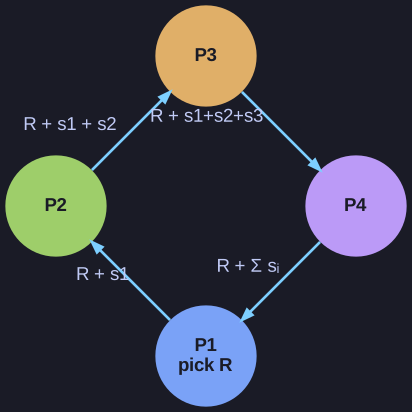
* Secure multi-party salary averaging: a random offset R hides each input. *
The classic example (salary averaging):
$n$ people want to calculate their average salary without anyone revealing their individual salary.
Classical solution: Everyone tells a trusted third party (e.g., an auditor) their salary, who computes and announces the average. Problem: you must trust this party.
MPC solution (no trusted third party needed):
- $P_1$ picks a large random number $R$ and adds their salary: sends $(R + s_1)$ to $P_2$
- $P_2$ adds their salary to the received sum: sends $(R + s_1 + s_2)$ to $P_3$
- This continues until $P_n$ sends the total back to $P_1$
- $P_1$ subtracts $R$ and divides by $n$ → average salary!
No one learns anyone else's individual salary, yet they all get the correct average.
The general principle:
- MPC provides a cryptographic protocol that replaces a trusted authority
- Participants can jointly compute any function while keeping their inputs private
- Applications: private auctions, secure voting, privacy-preserving analytics, joint financial computations
Why it matters: MPC represents a fundamental shift — from trusting institutions to trusting mathematics and protocols.
Go deeper:
 Secure multi-party computation - jointly compute a function over private inputs; includes the salary example.