Quiz Entry - updated: 2026.07.30
What is Shamir Secret Sharing, and how does it relate to Multi-Party Computation?
Shamir Secret Sharing (1979) splits a secret s into n shares such that any k shares can reconstruct s, but fewer than k shares reveal nothing. It's the foundational primitive that many MPC protocols use to distribute computation safely.
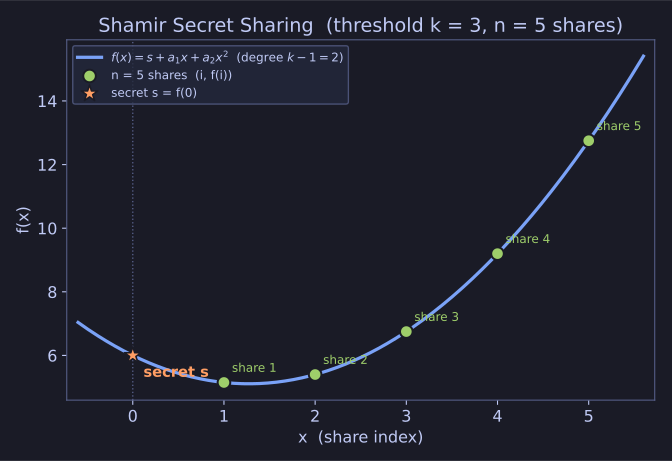
* The secret is the curve at x=0; any k=3 of n=5 shares reconstruct it, fewer reveal nothing. *
How it works (informally):
- To share a secret
swith thresholdk, pick a random polynomial of degreek−1whose constant term iss:f(x) = s + a₁·x + a₂·x² + … + a_{k-1}·x^{k-1}(all arithmetic mod a large prime) - Each shareholder
ireceives the share(i, f(i)). - To recover
s, anykshareholders interpolate the polynomial atx=0(Lagrange interpolation) and read off the constant term.
Properties:
- Information-theoretically secure: with
k−1shares, the secret is literally uniformly distributed — no computational assumption. - Linear: adding two shared secrets, or multiplying by a constant, can be done locally on each share. Multiplying two shared secrets requires more work — and that's where MPC protocols start to get clever.
Where it shows up:
- HashiCorp Vault, AWS KMS, Google Cloud HSM: master keys are stored as Shamir shares across hardware modules and operators.
- MPC wallets (Fireblocks, ZenGo): the private key never exists in one place — it's permanently held as shares.
- The Zettelchen-voting protocol (paper-slip MPC voting) is essentially Shamir-style additive secret sharing with threshold = all participants.
Tip: Shamir's "any k-of-n" property is the most-cited use of polynomial interpolation in cryptography. The same math underlies Reed-Solomon error correction (every CD and QR code uses it).
Go deeper:
 Shamir's secret sharing (Wikipedia) — the polynomial/Lagrange k-of-n construction.
- Secure multi-party computation (Wikipedia) — how secret sharing underpins MPC.