Quiz Entry - updated: 2026.07.30
What is signaling and how does it differ across network media types?
Signaling is how a 1 and a 0 are physically represented on the medium, and it differs by media: voltage on copper, light pulses on fiber, and modulated radio/microwaves over wireless.
Signaling is how bit values "1" and "0" are physically represented on the medium.
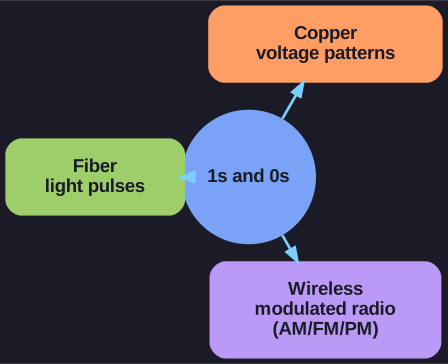
* The same bits are signalled differently per medium: voltage patterns on copper, light pulses on fiber, and modulated radio on wireless. *
The method varies by media type:
| Media Type | Signaling Method |
|---|---|
| Copper cable | Electrical signals (voltage patterns) |
| Fiber-optic cable | Light pulses (on/off or varying intensity) |
| Wireless | Microwave signals (AM, FM, or PM modulation) |
Go deeper:
-
 Line code — Wikipedia — how digital data is mapped to voltage, current, or photon patterns on a channel.
 -
Data signaling rate — Wikipedia — how the rate of those signalled bits is defined across media and modulation schemes.