What is the 5G Service-Based Architecture (SBA), and how does it differ from earlier core-network designs?
SBA builds the 5G core from network functions (NFs) that communicate over standardised HTTP/2-based REST APIs instead of rigid point-to-point interfaces. It cleanly separates control and user plane, and is designed for cloud-native, containerised, virtualised, horizontally scalable deployment.
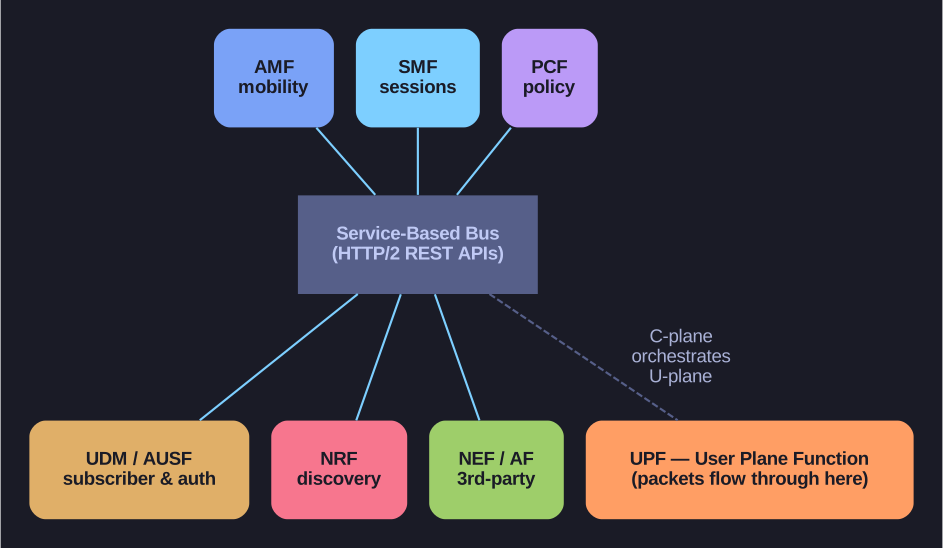
* SBA: network functions call each other over an HTTP/2 service bus. *
The three principles of the 5G/NR architecture:
- Clear separation between Radio Access Network (RAN) and 5G Core (5GC)
- Service-Based Architecture (SBA): uses standardised APIs instead of rigid interfaces
- Flexible, scalable, cloud-native network services in the core (cloudification)
How SBA works: network functions (NFs) communicate over HTTP/2-based APIs (REST-style), service-oriented rather than fixed wiring. Key NFs:
| NF | Role |
|---|---|
| AMF | access & mobility management |
| SMF / UPF | session & user-plane management |
| UDM / AUSF | subscriber data & authentication |
| PCF | policy control |
| NRF | service discovery (NFs find each other) |
| NEF / AF | exposure to / functions of third parties |
The big shift: earlier cores had rigid, point-to-point interfaces between fixed boxes. SBA turns the core into a set of software services calling each other over web APIs — so functions can be virtualised, containerised, scaled horizontally, and deployed flexibly (like any cloud microservice architecture).
Tip: SBA = "the core network rebuilt as cloud microservices talking HTTP/2." The NRF (service discovery) is the giveaway that this is a service mesh, not a fixed circuit diagram.
Go deeper:
 Advanced: 5G Service Based Architecture (SBA) (3G4G) — the canonical telecom-explainer channel contrasts the reference-point vs service-based representations of the 5G core and walks the NFs (AMF/SMF/UPF/NRF/…) — exactly this card, in motion.
 Network Slicing — S-NSSAI in detail (ShareTechnote) — the headline capability SBA unlocks: how slices are identified (S-NSSAI = SST + SD), the standardised slice types, and the registration/PDU-session signalling that selects a slice.