What is the Base Station Controller (BSC) and what role does it play in the GSM architecture?
The Base Station Controller (BSC) manages multiple Base Transceiver Stations (BTS) — it handles radio resource allocation, frequency management, handover between its BTS, and multiplexes connections towards the core network.
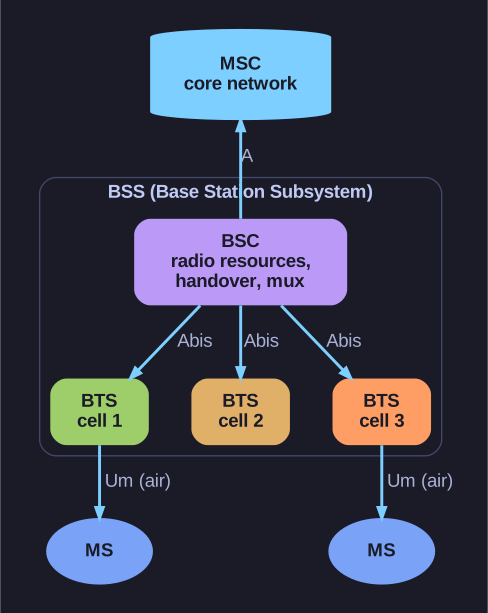
* BTS/BSC/BSS: one BSC drives several BTS, bundling traffic to the MSC. *
Functions:
- Controls multiple BTS (Base Transceiver Stations) — the actual radio antennas/transmitters — often many at once
- Reserves radio frequencies and assigns them to calls
- Handles handover between BTS stations under its control
- Multiplexes multiple connections before forwarding them on towards the core network (the fixed network)
Position in the hierarchy:
MS ←(Air Interface)→ BTS ←(Abis)→ BSC ←(A-Interface)→ MSC
Where MS = Mobile Station (the handset), BTS = Base Transceiver Station (radio antenna), BSC = Base Station Controller, and MSC = Mobile Switching Center (core-network switch).
The BSC sits between the radio access (BTS) and the core network (MSC). It's the "traffic controller" of the radio side — deciding which frequencies to assign, when to hand over a call to another BTS, and how to efficiently bundle traffic towards the MSC.
BSS (Base Station Subsystem): A BSC together with all its BTS stations forms a BSS. One BSS corresponds to a geographic area managed by a single mobile operator location.
Go deeper:
 Base station subsystem (Wikipedia) — the BSC's job (radio-channel allocation, measurements, BTS-to-BTS handover) and how BSC + its BTS form the BSS.