What is the classical (JTB) definition of knowledge, and what does each condition require?
Knowledge is justified true belief: S knows that p only if p is true, S believes p, and S is justified in believing p — all three are needed.
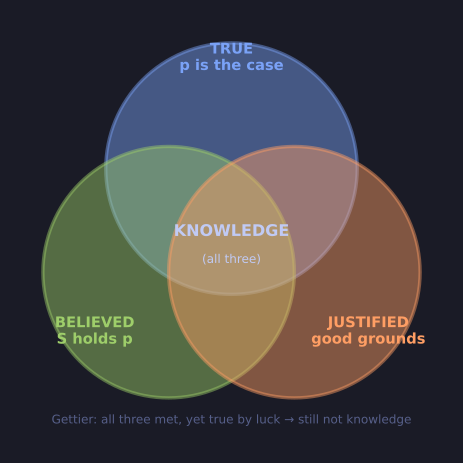
* Knowledge as justified true belief — the overlap of all three conditions; a Gettier case satisfies them yet is true only by luck. *
The classical definition of theoretical/propositional knowledge (traceable to Plato's Theaetetus): knowledge is justified, true belief. A subject S knows that proposition p — say, "it rained" — exactly when all three hold:
| Condition | Requires | Example (S = Sandra, p = "it rained") |
|---|---|---|
| Truth | p is actually the case | It really did rain |
| Belief | S holds p to be true | Sandra believes it rained |
| Justification | S has good grounds for believing p | Sandra has good reasons (wet street, forecast) |
All three are necessary. Drop truth and you have a justified false belief (a reasonable mistake). Drop belief and you don't hold the claim at all. Drop justification and a lucky correct guess would count as knowledge — which we don't want.
Tip: "JTB" = Justified, True, Belief. A true belief held for no good reason (a hunch that happens to be right) isn't knowledge — that's why justification is in there.
Go deeper:
 The analysis of knowledge — Stanford Encyclopedia of Philosophy — the JTB account and the debates around it.
- Epistemology — Wikipedia — where the three-part definition of knowledge sits in the wider field.