What is the composition fallacy, and how does division mirror it?
Composition: assuming the whole has a property just because its parts do. Division: assuming each part has a property just because the whole does. Both leap from part to whole without justification.
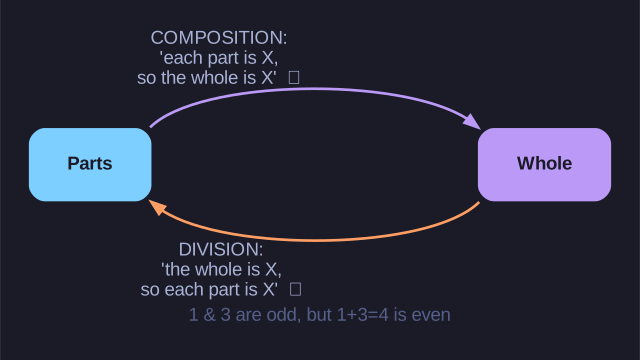
* Two mirror errors: inferring the whole from its parts (composition) or each part from the whole (division). *
| Composition | Division | |
|---|---|---|
| Direction | parts → whole | whole → parts |
| Bad inference | "each part is X, so the whole is X" | "the whole is X, so each part is X" |
They're mirror images and both fail because a property of the parts needn't transfer to the whole, or back.
- Composition: "Every player on the team is a superstar, so the team is a great team." (They might play together terribly.)
- Division: "The team averages a high salary, so every individual player is highly paid." (The average can hide low-paid members.)
Sometimes the inference is valid — "every part is made of brick, so the structure is brick" — but only when there's a reason the property carries over. The fallacy is assuming it always does.
Tip: Numbers make it vivid: 1 and 3 are odd, but their sum 4 is even (composition fails); 4 is even, but its part 1 is odd (division fails).
Go deeper:
 yourlogicalfallacyis.com — Composition/division — the part↔whole mix-up in one page.
 Wikipedia — Fallacy of composition — inferring the whole from its parts.
- Wikipedia — Fallacy of division — the mirror error, inferring each part from the whole.