What is the difference between a collision domain and a broadcast domain?
A collision domain is the set of devices that contend for one shared half-duplex medium (collisions are possible); a broadcast domain is the set of devices that receive each other's broadcast frames. Each switch port is its own collision domain; a router bounds a broadcast domain.
The two terms answer different questions: a collision domain is about who can clobber whose signal, while a broadcast domain is about how far a broadcast can travel. They are bounded by different devices — a switch shrinks collision domains but not broadcast domains, and only a router (or VLAN) ends a broadcast domain.
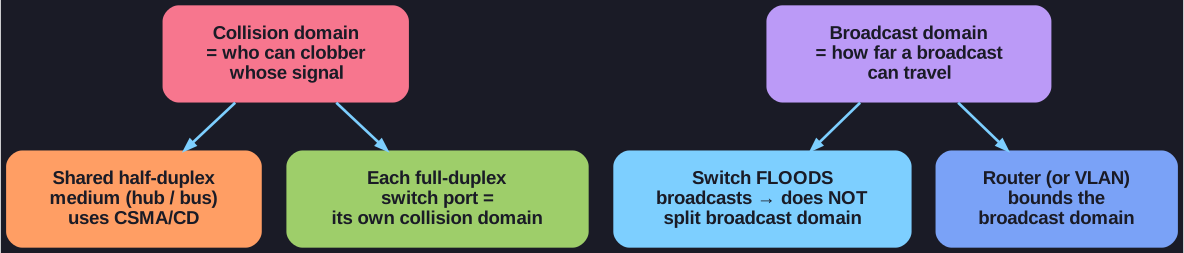
* A collision domain is who can clobber whose signal (each full-duplex switch port is its own); a broadcast domain is how far a broadcast travels, bounded by a router or VLAN. *
Collision domain:
- A network segment where frames can collide if two devices transmit at once
- Exists on shared, half-duplex media (hubs, legacy bus Ethernet), which is why those use CSMA/CD
- A full-duplex switch port is its own collision domain, so collisions are eliminated on switched links
Broadcast domain:
- All devices that will receive a broadcast frame (destination
FF-FF-FF-FF-FF-FF) - Switches flood broadcasts out all ports, so they do not break up a broadcast domain
- A router does not forward broadcasts, so a router (or VLAN boundary) terminates a broadcast domain
Why it matters: Replacing hubs with switches shrinks collision domains to a single link each, while limiting broadcast domains (via routers/VLANs) controls broadcast traffic. (Standard networking knowledge; the 2016 source mentions collision fragments and broadcast domains but does not give a side-by-side definition.)
Go deeper:
-
 Collision domain (Wikipedia) — why a hub is one big collision domain and a switch gives each port its own, eliminating collisions on full-duplex links.
 -
Broadcast domain (Wikipedia) — the other half of the pair: switches flood broadcasts while a router or VLAN bounds the domain.