Quiz Entry - updated: 2026.10.26
What is the difference between a one-way function with a trapdoor and one without a trapdoor?
A trapdoor is a secret "shortcut" that makes the inverse computation easy — RSA has one (the prime factors), while the discrete logarithm does not.
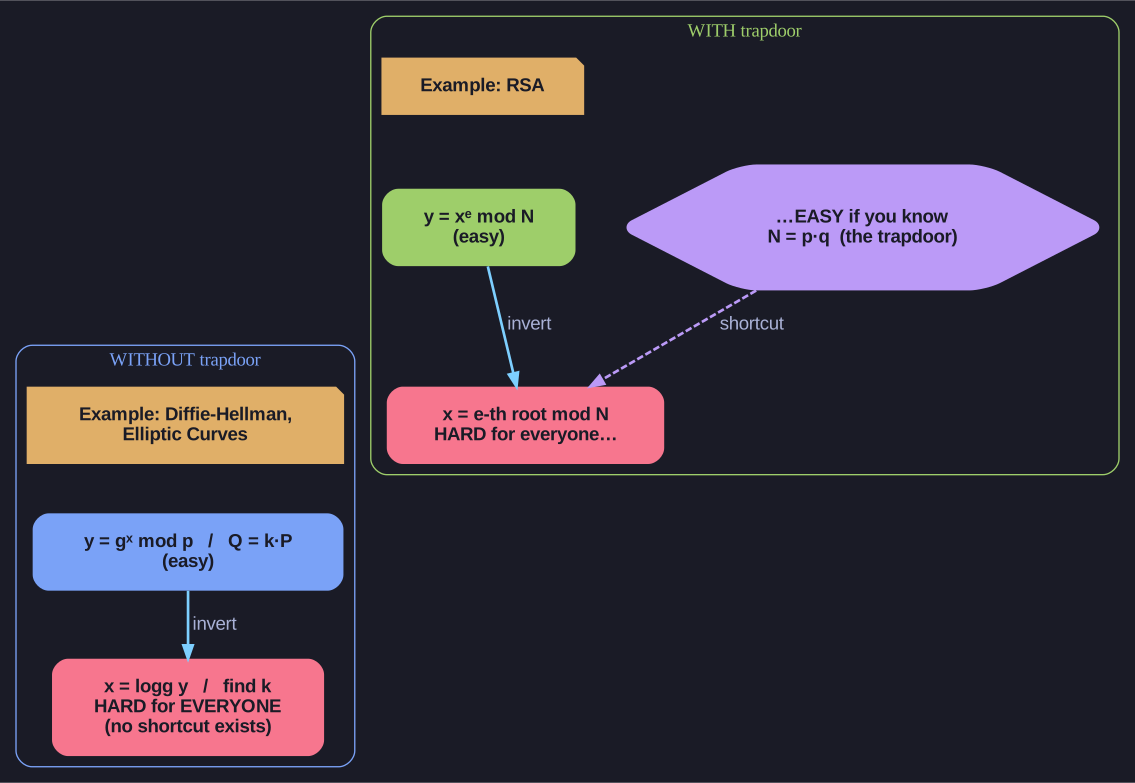
* With a trapdoor the owner has a secret shortcut back; without one the inverse is hard for everyone. *
With trapdoor:
- Computing $y = f(x)$ is easy
- Computing $x = f^{-1}(y)$ is infeasible without the trapdoor
- But $x = f^{-1}(y)$ becomes easy with the trapdoor
- Example — RSA: $y = x^e \mod N$ is easy. The inverse ($e$-th root mod $N$) is hard unless you know the prime factorization $N = p \cdot q$ (the trapdoor).
Without trapdoor:
- Computing $y = f(x)$ is easy
- Computing $x = f^{-1}(y)$ is hard for everyone — no shortcut exists
- Example — Discrete Logarithm (Diffie-Hellman): $y = g^x \mod p$ is easy. Finding $x = \log_g y \mod p$ is hard for everyone, including Alice and Bob.
- Example — Elliptic Curves: $Q = k \cdot P$ is easy. Finding $k$ from $Q$ and $P$ (point division) is hard for everyone.
Tip: Think of it as: with a trapdoor, you built the lock and have the master key. Without a trapdoor, even the locksmith can't pick it — the one-way property is fundamental to the math itself.
Go deeper:
 Trapdoor function (Wikipedia) — the RSA and Rabin trapdoors, and why a plain one-way function (like a hash) has none.