Quiz Entry - updated: 2026.07.30
What is the difference between an autonomous AP and a controller-based (lightweight) AP?
An autonomous AP is a standalone device configured individually via CLI/GUI. A controller-based (lightweight) AP is centrally managed by a Wireless LAN Controller (WLC) via the CAPWAP protocol — the AP itself has minimal configuration.
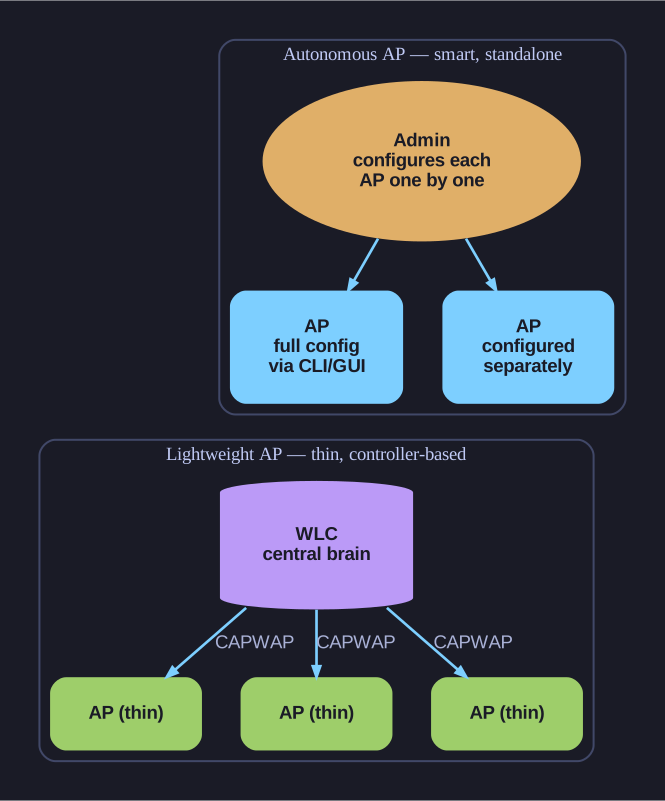
* Autonomous vs lightweight (WLC-managed) APs. *
| Feature | Autonomous AP | Controller-Based (Lightweight) AP |
|---|---|---|
| Configuration | Individually via CLI or GUI | Centrally via WLC |
| Management | Each AP managed separately | WLC manages all APs automatically |
| Intelligence | Self-contained — all decisions local | "Dumb" — WLC makes most decisions |
| Protocol | Standalone | LWAPP/CAPWAP to communicate with WLC |
| Scalability | Poor (1-3 APs manageable) | Excellent (hundreds of APs per WLC) |
| Best for | Small office, home | Enterprise, campus, large deployments |
| Firmware updates | Per-AP | WLC pushes to all APs simultaneously |
Why enterprises use controller-based APs:
- Managing 200 APs individually would be an administrative nightmare
- WLC provides centralized security policies, channel assignment, power management, and roaming
- APs are interchangeable — replace a failed AP, and the WLC automatically configures it
Tip: Think of autonomous APs as "smart" (self-sufficient) and lightweight APs as "thin clients" that depend on the WLC server for their brains.
Go deeper:
 Wireless LAN controller (Wikipedia) — why centralized WLC management of lightweight APs scales where autonomous APs don't.