Quiz Entry - updated: 2026.07.30
What is the difference between Authentisierung and Authentifizierung in German security terminology?
Authentisierung = the user proves who they are (active, by the user). Authentifizierung = the system verifies the proof (active, by the system). Side-effect of being in German — both translate to "authentication" in English.
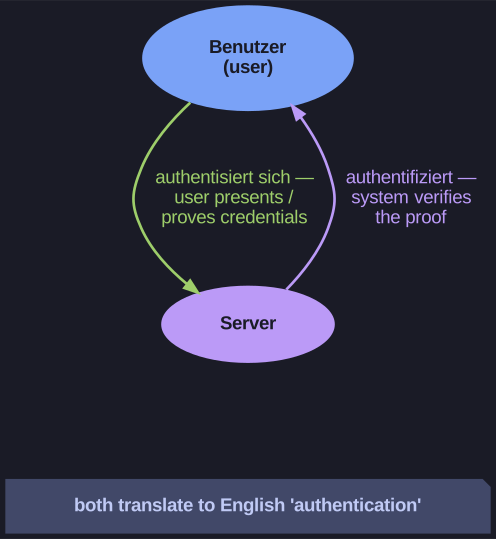
* Two directions of one handshake — both translate to English "authentication". *
The relationship:
- Benutzer authentisiert sich am Server — the user provides credentials (presents themselves).
- Server authentifiziert den Benutzer — the server checks those credentials and decides yes/no.
Benutzer ──[authentisiert sich am]──→ Server
Benutzer ←──[authentifiziert den]──── Server
Why the distinction:
- Strictly in German, these are two sides of the same handshake — the act of proving and the act of verifying.
- In day-to-day English we say "the user authenticates" and "the server authenticates the user" using the same verb — the context disambiguates.
- German Wikipedia treats them as a matched pair: every authentisierung (the user's act of presenting proof) needs an authentifizierung (the verifier's act of checking it) on the other end.
Tip: when you read German security material, authentisierung is almost always what the user/client does, and authentifizierung is what the server does. They're not synonyms; they're the two directions of the same protocol step.
Go deeper:
 Authentifizierung (German Wikipedia) — the German distinction between Authentisierung, Authentifizierung and Authentifikation.