What is the difference between circuit-switched and packet-switched transmission in mobile networks?
Circuit-switched transmission reserves a dedicated connection for the entire duration of a call (like old telephone switchboards); packet-switched transmission breaks data into packets that share the network resources (like the internet).
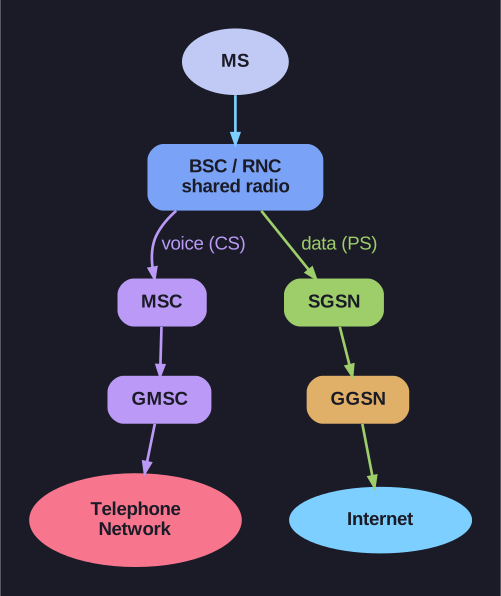
* The two 2G/3G core domains: circuit-switched voice beside packet-switched data. *
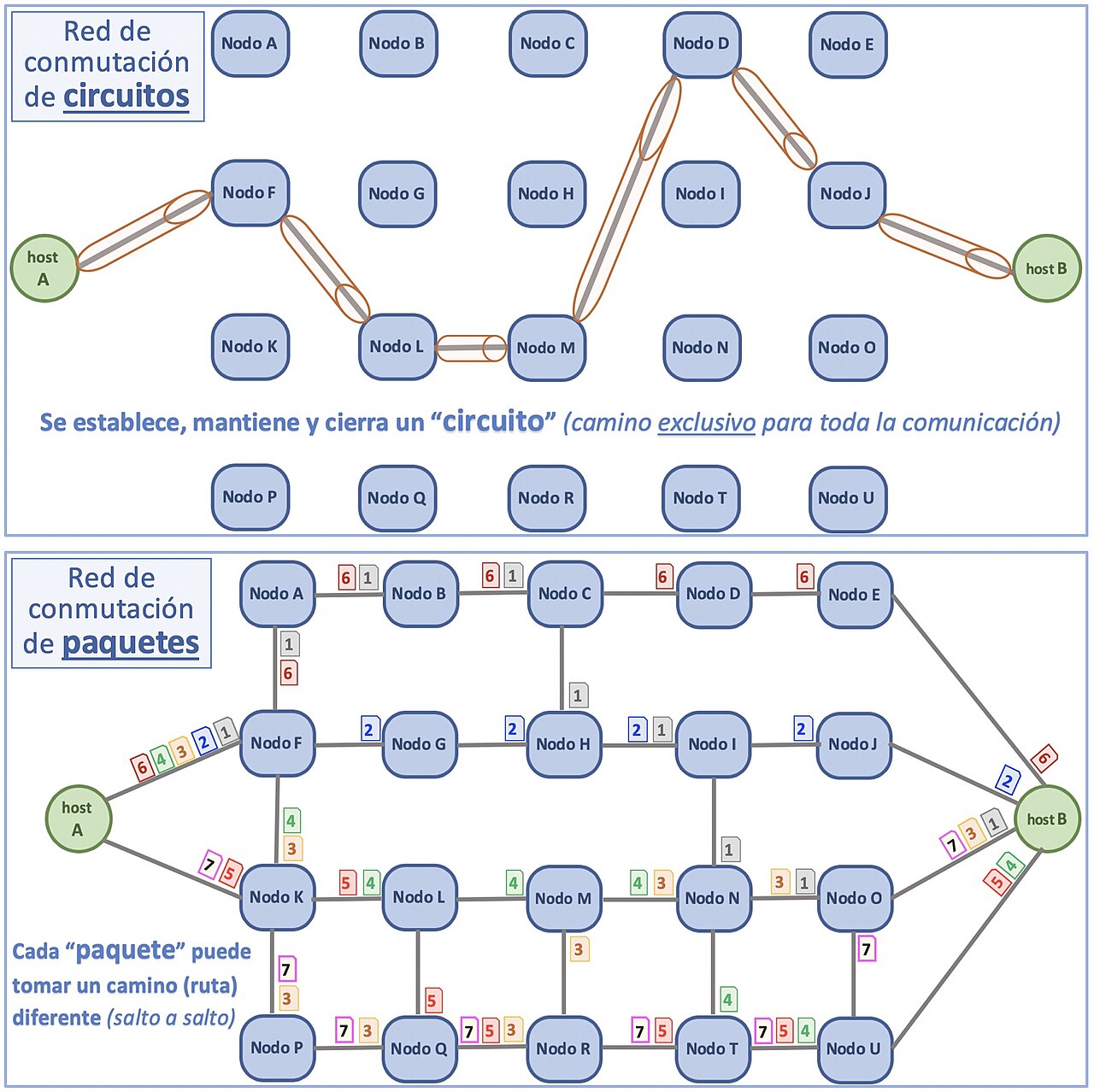
* Circuit-switched path vs packet-switched routing. — Acorletti, CC BY-SA 4.0, via Wikimedia Commons. *
Circuit-switched (verbindungsorientiert):
- A dedicated, exclusive connection is established between two parties
- The channel is reserved for the entire duration — even during silence
- Like old-fashioned telephone operators physically plugging cables between callers
- Used for: voice calls in 2G (GSM) and 3G (UMTS)
- Advantage: guaranteed quality, constant latency
- Disadvantage: wastes resources during silence (typically 40-60% of a voice call)
Packet-switched (paketorientiert):
- Data is broken into small packets that are routed independently
- Packets from multiple users share the same network resources
- Routers forward packets hop-by-hop toward the destination, where they're reassembled
- Used for: data in 2.5G (GPRS), 3G (UMTS), and everything in 4G/5G
- Advantage: efficient — resources only used when actually sending data
- Disadvantage: variable latency, potential congestion
The trend across generations: Mobile networks have steadily moved from circuit-switched to packet-switched. 4G (LTE) was the tipping point — it eliminated circuit switching entirely. Even voice calls became packet-switched (VoLTE).
Go deeper:
 Circuit switching (Wikipedia) — the dedicated-channel model (PSTN, GSM voice) with its guaranteed-but-wasteful trade-off.
- Packet switching (Wikipedia) — the shared-resource model and why it underlies everything in 4G/5G.