Quiz Entry - updated: 2026.07.30
What is the difference between convergent and divergent thinking?
Convergent thinking narrows down to one answer; divergent thinking expands to many possibilities.
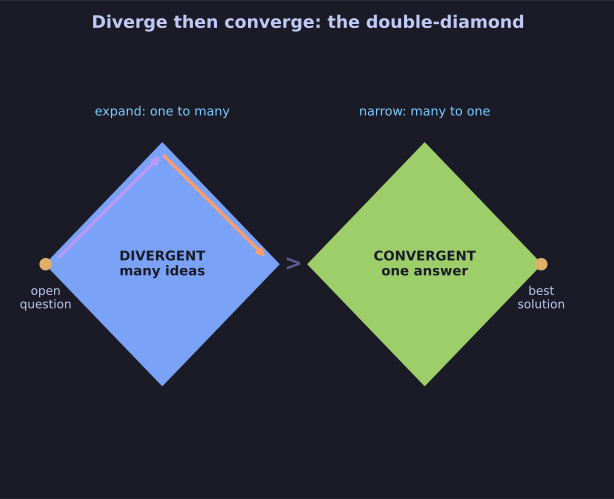
* Diverge wide then converge narrow — the double-diamond shape. *
| Aspect | Convergent Thinking | Divergent Thinking |
|---|---|---|
| Direction | Narrows (many → one) | Expands (one → many) |
| Driven by | Logic and facts | Imagination and curiosity |
| Starting point | A defined problem | An open question |
| Goal | Find THE correct answer | Generate MANY possible ideas |
| Mode | Analytical, structured | Creative, free-flowing |
| Also called | Critical/Vertical/Analytical/Linear thinking | Creative/Horizontal thinking/Brainstorming |
| Example | "What caused this server crash?" | "How might an attacker exploit this system?" |
How they relate to lateral thinking:
- Vertical thinking is primarily convergent — following logical steps to a conclusion
- Lateral thinking uses divergent thinking to generate unusual ideas, then convergent thinking to evaluate them
- Lateral thinking = "Thinking Outside the Box" — using both modes together
- Effective problem-solving requires both modes — diverge to explore possibilities, then converge to select the best solution
Tip: Think of it as a diamond shape: diverge wide (brainstorm), then converge narrow (decide). Many creativity frameworks (like Design Thinking) follow this "double diamond" pattern.
Go deeper:
 Divergent thinking (Wikipedia) — the expand-to-many-ideas mode and how it pairs with convergence.
- Design thinking (Wikipedia) — the diverge-then-converge process behind the "double diamond".