Quiz Entry - updated: 2026.07.30
What is the difference between full-duplex and half-duplex communication?
Full-duplex sends and receives simultaneously (no collisions); half-duplex carries one direction at a time and can collide.
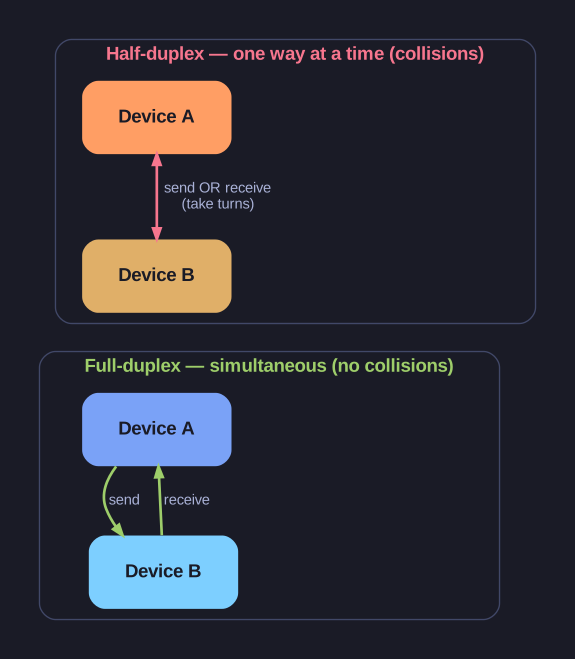
* Half-duplex vs full-duplex. *
| Feature | Full-Duplex | Half-Duplex |
|---|---|---|
| Direction | Bidirectional (simultaneous) | Unidirectional (one at a time) |
| Collisions | No collision domain | Collisions can occur |
| Bandwidth efficiency | 100% in both directions | Reduced due to waiting |
| Effective throughput | Doubles stated bandwidth | Less than stated bandwidth |
Key details:
- Full-duplex requires microsegmentation — one device per switch port
- A switch port in full-duplex has no collision domain (collision detection is disabled on the NIC (Network Interface Card))
- Gigabit Ethernet and 10 Gb NICs require full-duplex — they cannot operate in half-duplex
- A 100 Mbps full-duplex link effectively provides 200 Mbps total throughput (100 Mbps each direction simultaneously)
Tip: Think of a hallway — half-duplex is a narrow hallway where people must take turns. Full-duplex is a two-lane road where traffic flows both ways simultaneously.
Go deeper:
 Duplex (telecommunications) (Wikipedia) — clear full vs half vs simplex definitions with everyday analogies.