What is the difference between half-duplex and full-duplex communication?
Half-duplex lets only one device send or receive at a time on a shared medium; full-duplex lets both devices send and receive simultaneously over a dedicated point-to-point link.
Duplex describes the direction of traffic flow on a link. Half-duplex is one-way-at-a-time, like a walkie-talkie: when several devices share one medium they must take turns, so only one can transmit at any instant. Full-duplex is two-way-at-once, like a phone call. Full-duplex requires a dedicated point-to-point connection (or separate transmit and receive paths), not a contended shared medium — which is why it belongs to switched Ethernet, where each device has its own link to a switch port, rather than to a hub-based shared segment.
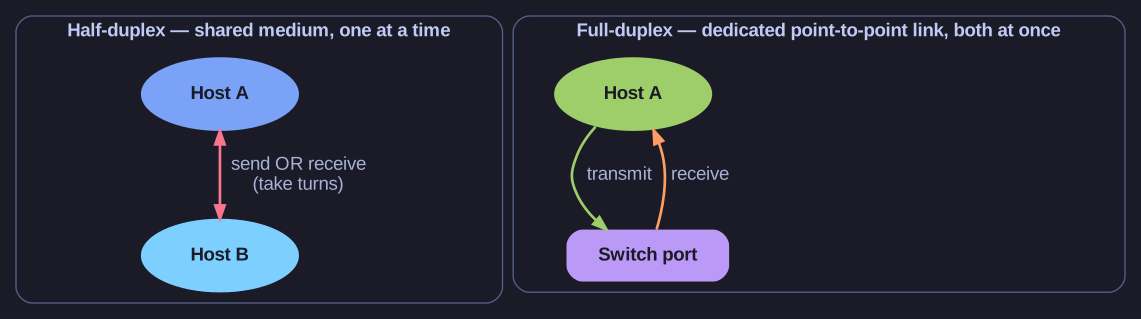
* Half-duplex shares one medium and takes turns; full-duplex uses a dedicated point-to-point link and sends both ways at once. *
| Mode | Description | Usage |
|---|---|---|
| Half-duplex | Only one device can send OR receive at a time on a shared medium | WLANs, legacy bus topologies with Ethernet hubs |
| Full-duplex | Both devices can simultaneously transmit and receive over a dedicated point-to-point link | Ethernet switches |
Key insight: Modern Ethernet switches operate in full-duplex mode, which doubles the effective bandwidth compared to half-duplex.
Go deeper:
 Ethernet over twisted pair (Wikipedia) — modern speeds define only full-duplex point-to-point links and drop shared-medium CSMA/CD, nailing the "not a shared medium" point.
- Half-duplex and full-duplex (Study-CCNA) — contrasts hub half-duplex (collisions, one at a time) with switched full-duplex (simultaneous, collision-free).
- Duplex (telecommunications) (Wikipedia) — general reference framing duplex systems as point-to-point.