What is the difference between receipt-freeness and coercion-resistance in e-voting?
Receipt-freeness: the voter cannot prove (even if they want to) how they voted. Coercion-resistance: even an active attacker watching the voter cannot force them to vote a particular way.
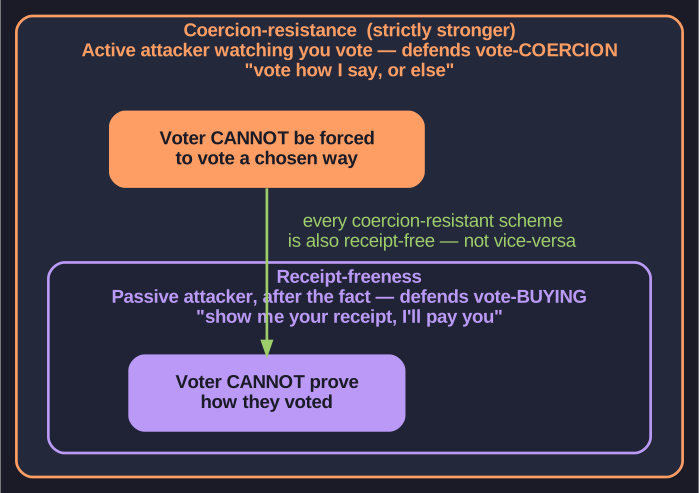
* Coercion-resistance is the strictly stronger property — it defends against an active coercer, not just vote-buying. *
| Property | Defends against | Attacker model |
|---|---|---|
| Receipt-freeness | Vote-buying ("show me your receipt, I'll pay you") | Passive — looks at evidence after the fact |
| Coercion-resistance | Vote-coercion ("vote how I tell you, or else") | Active — watches the voter cast their ballot |
Coercion-resistance is strictly stronger than receipt-freeness — every coercion-resistant scheme is also receipt-free, but not vice versa.
Why this matters for internet voting:
- A polling-station vote is implicitly receipt-free and coercion-resistant — the voting booth physically prevents proving how you voted.
- An internet vote happens at home (or worse: at a coercer's home). The crypto has to do all the work that the polling-booth curtain used to do.
Techniques used in academic schemes:
- Fake credentials (Civitas, JCJ) — voters can hand out a valid-looking credential to a coercer that produces a vote silently discarded.
- Designated verifier proofs — only the voter can verify their receipt; anyone else sees a meaningless transcript.
- Re-voting — a later vote overrides an earlier one, so a coerced vote can be silently rewritten.
Tip: Switzerland's e-voting debate has hinged on coercion-resistance for years. Critics argue no internet voting system can credibly match the polling booth on this dimension — which is why the Swiss Post system remains under tight restriction.
Go deeper:
 Coercion-Resistant Electronic Elections (Juels, Catalano, Jakobsson) — the paper that formalised coercion-resistance.
- Electronic voting (Wikipedia) — receipt-freeness and coercion context.