Quiz Entry - updated: 2026.07.30
What is the difference between STP (Spanning Tree Protocol), PVST+ (Per-VLAN Spanning Tree Plus), RSTP (Rapid Spanning Tree Protocol), and Rapid PVST+?
They represent an evolution from basic loop prevention (STP (Spanning Tree Protocol)) to faster, per-VLAN, feature-rich variants (Rapid PVST+ (Per-VLAN Spanning Tree Plus)).
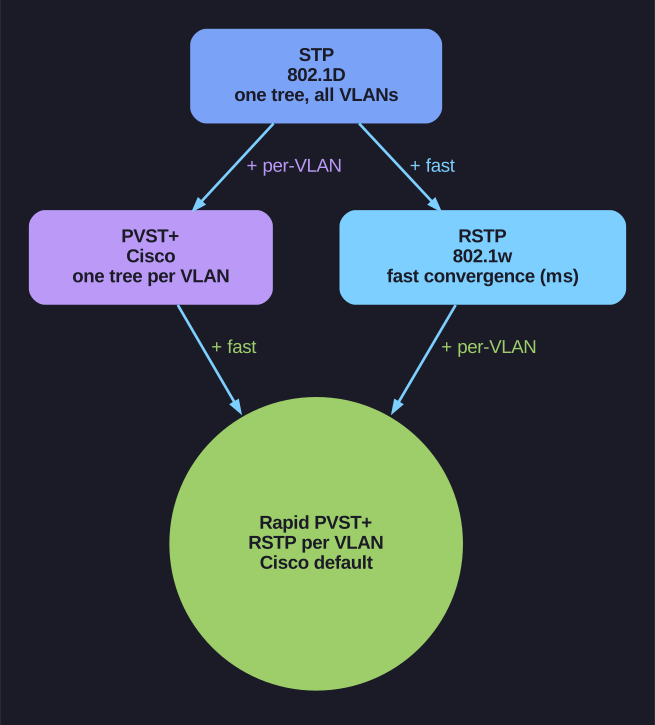
* The two upgrades relating the STP variants. *
| Variant | Standard | Per-VLAN? | Key Feature |
|---|---|---|---|
| STP | 802.1D-1998 | No (one instance for all VLANs (Virtual Local Area Networks)) | Original — Common Spanning Tree (CST) |
| PVST+ (Per-VLAN Spanning Tree Plus) | Cisco proprietary | Yes | Separate 802.1D instance per VLAN + PortFast, UplinkFast, BackboneFast, BPDU (Bridge Protocol Data Unit) guard |
| 802.1D-2004 | IEEE | No | Updated standard incorporating 802.1w |
| RSTP (Rapid Spanning Tree Protocol) | 802.1w | No | Faster convergence (milliseconds vs. 30-50s) |
| Rapid PVST+ | Cisco (802.1w per VLAN) | Yes | RSTP + per-VLAN instances + PortFast, BPDU guard, etc. |
| MSTP (Multiple Spanning Tree Protocol) | 802.1s (IEEE) | Maps multiple VLANs to instances | Reduces overhead by grouping VLANs |
| MST (Multiple Spanning Tree) | Cisco (802.1s) | Up to 16 instances | Cisco implementation of MSTP |
What Cisco switches run by default: Cisco IOS (Internetwork Operating System) 15.0+ runs PVST+ by default. You must explicitly configure Rapid PVST+ mode to get faster convergence.
Go deeper:
 Varieties of Spanning Tree Protocols (Cisco Press) — side-by-side comparison of STP/PVST+/RSTP/Rapid PVST+/MSTP by standard, convergence and resource use.