What is the Feistel structure used in block ciphers like DES?
A Feistel cipher splits each block into two halves and processes them through multiple rounds where one half is transformed using a round function and XOR'd with the other half, then the halves are swapped.
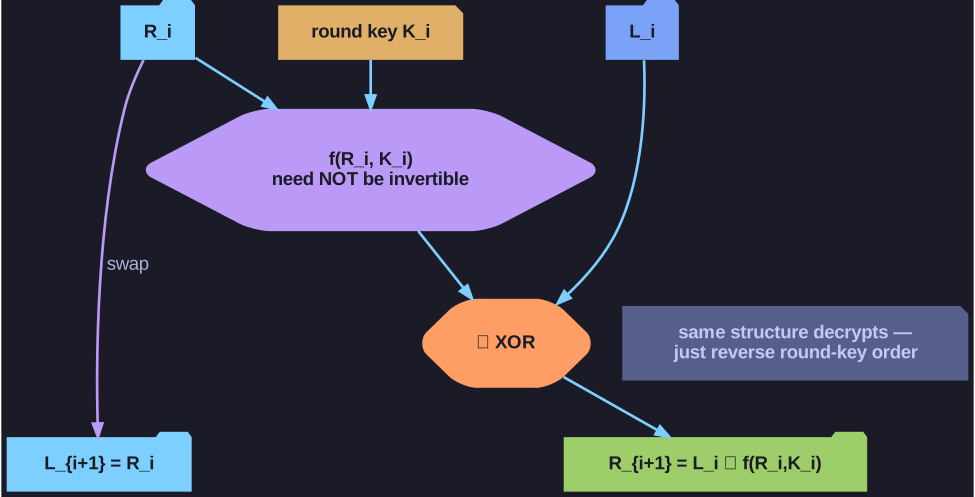
* One Feistel round: transform $R$ with $f$, XOR into $L$, then swap — the same structure also decrypts. *
Its real elegance is practical: because the construction is self-inverting, the same circuitry runs both encryption and decryption (you only reverse the order of round keys), and the round function $f$ never has to be invertible. Both mattered enormously when DES had to fit on 1970s hardware, which is why the structure outlived DES into Blowfish, Twofish, and many others.
One round of Feistel: input $(L_i, R_i)$
$$\begin{aligned} L_{i+1} &= R_i \\ R_{i+1} &= L_i \oplus f(R_i, K_i) \end{aligned}$$
Key advantages:
- Encryption and decryption use the same structure — just reverse the key schedule (apply round keys in reverse order)
- The round function $f$ does NOT need to be invertible — this gives designers more freedom
- Proven structure used in DES, 3DES, Blowfish, Twofish, and many others
How decryption works:
- Run the same algorithm but apply round keys $K_r, K_{r-1}, \dots, K_1$ in reverse order
- The Feistel structure guarantees this recovers the plaintext
Note: AES does NOT use a Feistel structure — it uses a substitution-permutation network (SPN) instead.
Go deeper:
 Feistel Cipher (Computerphile) — Mike Pound walks through the split-transform-XOR-swap round and why the same circuit decrypts.
 Feistel cipher (Wikipedia) — why the round function need not be invertible, and who uses it.