What is the fundamental difference between "signing with the private key" and "encrypting with the private key"?
They are NOT the same thing, even though in RSA the mathematical operation ($m^d \mod N$) looks identical. Signing provides integrity and non-repudiation. "Encrypting with a private key" is a misleading term that provides neither confidentiality nor integrity.
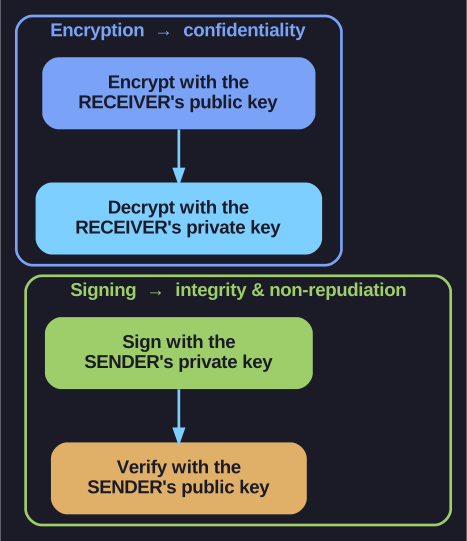
* Encryption uses only the receiver's key pair; signing uses only the sender's. *
Why the distinction matters:
| Signing | "Encrypting with private key" | |
|---|---|---|
| Goal | Prove authorship, ensure integrity | Misleading — provides nothing useful |
| Who can read it? | Everyone (using public key) | Everyone (using public key) — no confidentiality! |
| What it proves | Only the key holder could have created it | Nothing meaningful |
| Standard practice | Sign $h(m)$ with padding | Not a real operation |
Why "encrypt with private key" is wrong terminology:
- Encryption's purpose is confidentiality — keeping data secret
- If everyone can "decrypt" with the public key, there's no confidentiality
- What people mean when they say this is signing — but the goals and security properties are fundamentally different
- The keys play the wrong roles. Encryption only ever involves the receiver's key pair (encrypt with their public key, they decrypt with their private key). Signing only ever involves the sender's key pair (sign with the sender's private key, anyone verifies with the sender's public key). Calling signing "encryption" mixes up whose keys are in play — which also matters legally, since export-control regimes that restricted encryption did not apply to signatures.
For RSA specifically:
- Sign: $s = h(m)^d \mod N$ — produces a signature on the hash
- Encrypt: $c = m^e \mod N$ — produces a ciphertext only the private key holder can decrypt
- The mathematical structure is similar, but the purpose, padding, and security guarantees differ completely
RSA is a signature "with message recovery": verification raises $s$ to $e$ and gets the (hashed) message back, which is then compared with the recomputed value. Most other schemes work without message recovery: verification checks an equation and never reproduces the message (an exception is Nyberg-Rueppel, which still cannot encrypt).
For non-RSA algorithms: Signing and encryption use entirely different computations (DSA, Schnorr, ECDSA cannot encrypt at all; Elgamal and elliptic curves can do both, but with completely different procedures), making the confusion impossible.
Go deeper:
 Digital signature (Wikipedia) — how signing differs from encryption and why it yields non-repudiation.