What is the IMSI catcher, and what two capabilities does it have (passive vs. active)?
An IMSI catcher exploits GSM's one-sided authentication by impersonating a base station. Passively (GA 090) it forces phones to send their IMSI instead of TMSI to determine a subscriber's identity; actively (GA 900) it has its own SIM and sits as a man-in-the-middle to also intercept outgoing calls.
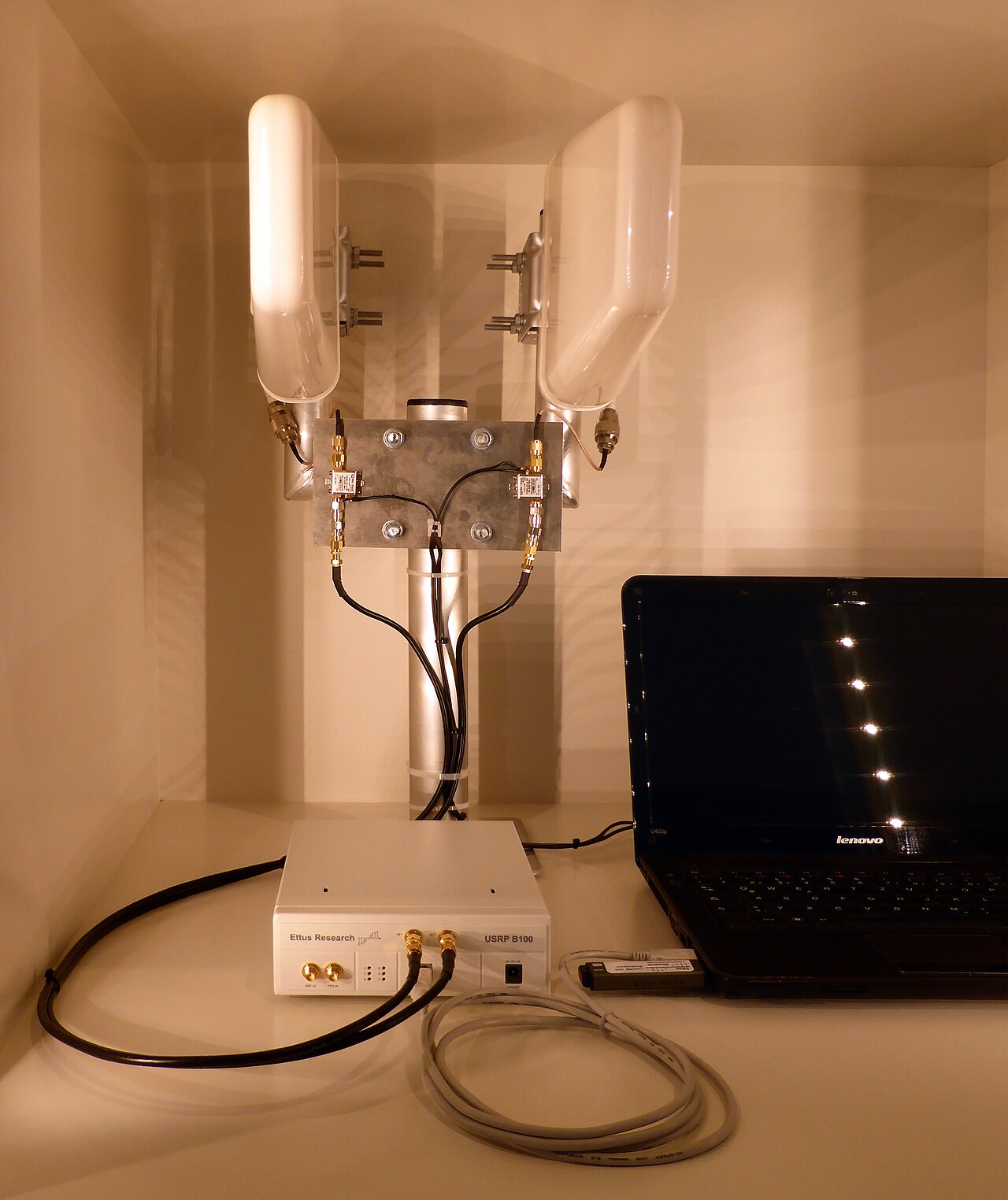
* A real IMSI-catcher device. — 1971markus, CC BY-SA 4.0, via Wikimedia Commons. *
Why it works: GSM authenticates only the phone, not the base station — and a phone always attaches to the strongest signal. So a fake base station with a strong signal will be trusted.
Two capability levels:
| Mode | Capability |
|---|---|
| Identity catching (GA 090) | Forces the phone to transmit its IMSI instead of the TMSI → reveals the subscriber's identity. The catcher poses as a base station the phone must (re-)identify to |
| Call interception (GA 900) | The catcher has its own SIM, poses as a BS toward the phone and as a MS toward the real BS → full man-in-the-middle, monitoring outgoing calls |
The enabling downgrade: since the catcher controls the "network" side, it can also tell the phone to use A5/0 (no encryption) — a downgrade attack — so calls are trivially readable.
Tip: The IMSI catcher is the practical payoff of two GSM design flaws working together: one-sided authentication (lets you fake a BS) + downgrade capability (lets you strip encryption). Mutual authentication in UMTS/LTE is the direct fix.
Go deeper:
 Fangespielen mit IMSI-Catchern — oshie (CCC Camp 2019) — how catchers actually work across 2G–4G and the telltale signs that betray them (German, English audio track available).
 Gotta Catch 'Em All — EFF — a deeper technical explainer of passive vs. active catchers, the TAU-Reject LTE downgrade, and detection.
- IMSI-catcher (Wikipedia) — the passive vs. active fake-base-station modes and the downgrade-to-A5/0 trick (feeds the image carousel).
- IMSI-Catcher: surveillance still possible in 5G networks (heise, 2023) — the same one-sided-trust weakness chased into 5G: why SUCI was meant to kill identity-catching and how researchers showed it can still leak (German).
- 5G anonymity and the SUCI (Mpirical) — the 5G fix this attack motivated: how the SUCI encrypts the permanent SUPI with the home network's public key so an attacker never sees a cleartext IMSI on the air.