Quiz Entry - updated: 2026.07.30
What is the interference paradox in wireless networks?
When experiencing high interference, a device can increase its transmit power to improve its own SNR — but this increases interference for everyone else, potentially triggering a chain reaction.
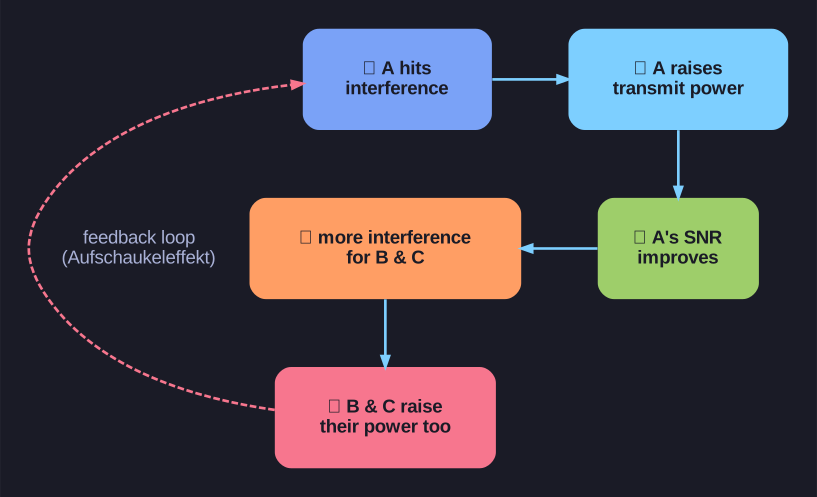
* The interference paradox: a positive-feedback power race. *
The paradox:
- Device A experiences interference and increases its transmit power
- This improves A's SNR → A's connection gets better
- But A's stronger signal now causes more interference for nearby devices B and C
- B and C may also increase their power to compensate
- This creates a positive feedback loop (Aufschaukeleffekt) where everyone keeps raising power
Sources of interference:
- Other radio sources on the same frequency band (other WLANs, Bluetooth)
- A classic example: a 2.4 GHz mobile phone interfering with 802.11b Wi-Fi
- Electromagnetic noise from household appliances (microwave ovens operate at ~2.45 GHz)
Real-world solution: This is why standards like LTE and 5G include power control mechanisms — the network tells each device exactly how much power to use, preventing this arms race. Wi-Fi uses a different approach: listen-before-talk (carrier sense) to avoid transmitting when others are active.
Go deeper:
 Power control (Wikipedia) — the transmit-power-control mechanism that prevents the power arms race.
- Near–far problem (Wikipedia) — the positive-feedback escalation where everyone boosting power defeats itself.