Quiz Entry - updated: 2026.07.30
What is the IPv4 static route command syntax, and what are the three ways to specify the next hop?
The command is ip route network mask {next-hop | exit-interface | both} [AD]. The three forms are: next-hop IP (Internet Protocol) only (recursive lookup), exit interface only (directly connected behavior), or fully specified (both — recommended for Ethernet).
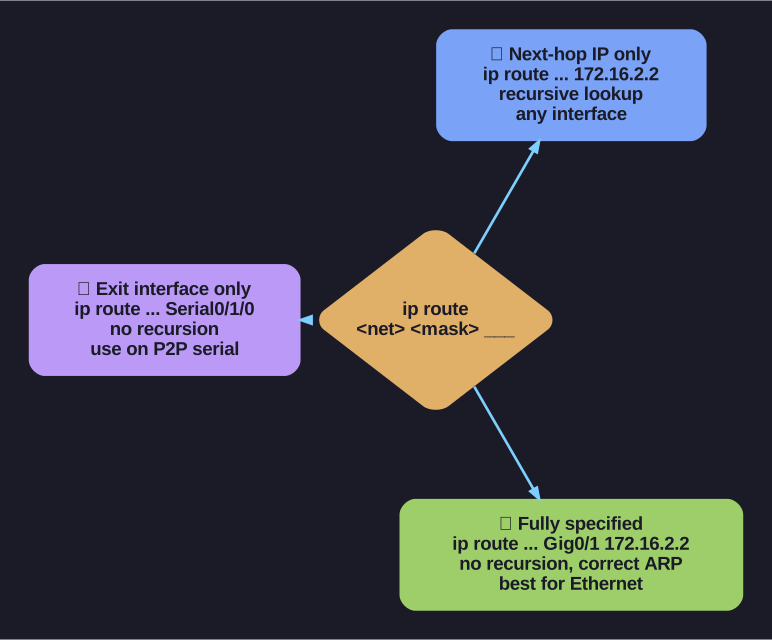
* Three ways to specify the next hop. *
Form 1 — Next-hop IP only (most common):
R1(config)# ip route 172.16.1.0 255.255.255.0 172.16.2.2
- Router performs a recursive lookup — first finds the route to 172.16.2.2, then uses that route's exit interface
- Works on any interface type (serial, Ethernet, tunnel)
- Routing table shows:
S 172.16.1.0/24 [1/0] via 172.16.2.2
Form 2 — Exit interface only (directly connected static):
R1(config)# ip route 172.16.1.0 255.255.255.0 Serial0/1/0
- No recursive lookup needed — sends out the specified interface directly
- On point-to-point links (serial): Works perfectly — there's only one neighbor
- On multi-access links (Ethernet): Problematic — router sends ARP (Address Resolution Protocol) for every destination IP on that interface, relying on Proxy ARP
- Routing table shows:
S 172.16.1.0/24 is directly connected, Serial0/1/0
Form 3 — Fully specified (both — recommended for Ethernet):
R1(config)# ip route 172.16.1.0 255.255.255.0 GigabitEthernet0/1 172.16.2.2
- Specifies both the exit interface AND the next-hop IP
- No recursive lookup, no Proxy ARP issues
- Best practice for Ethernet/multi-access interfaces
Tip: Use next-hop IP for most situations. Use fully specified routes when the exit interface is Ethernet. Only use exit-interface-only on point-to-point serial links.
Go deeper:
 Proxy ARP (Wikipedia) — the Proxy-ARP behaviour that makes exit-interface-only routes problematic on Ethernet.