What is the jamming threat against the LTE UE radio interface, and why is LTE particularly susceptible?
Jamming the LTE radio prevents the phone from transmitting by decreasing the signal-to-noise ratio with static or high-power noise across a frequency band. Research suggests LTE is especially vulnerable because of the small amount of control signaling — and it can even block emergency calls. Mitigation is unclear.
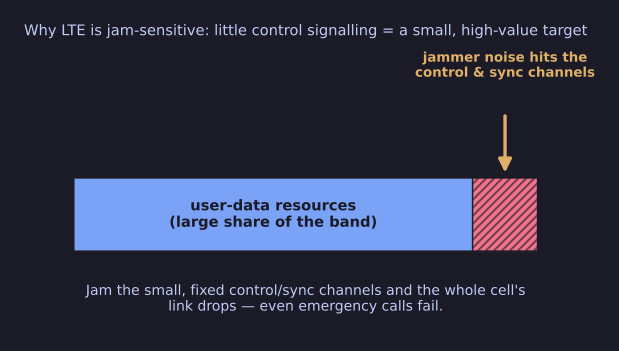
* Why LTE is jam-sensitive: only a small, fixed slice of the band carries control/sync — jam that and the whole cell's link drops. *
The threat:
- Jamming the LTE radio prevents the phone from successfully transmitting
- It works by decreasing the signal-to-noise ratio — transmitting static and/or noise at high power across a frequency band
- Research suggests that, due to the small amount of control signaling in LTE, this attack is possible — knocking out a few critical control channels disproportionately disrupts the whole link
- It prevents emergency calls — a safety-critical impact
The mitigation:
- Unclear. Further research is required and may require changes to the 3GPP standards to mitigate this attack.
Why LTE's efficiency is also a weakness: LTE concentrates control information into compact, well-defined channels. That's spectrally efficient, but it means an attacker doesn't need to jam the whole band — just the small, predictable control regions. Efficiency and jam-resistance are in tension.
Tip: Jamming is an availability attack (it denies service); it doesn't break confidentiality. But "no service" includes "no emergency calls," which is why it's taken seriously.
Go deeper:
 Lichtman, Reed et al. — Vulnerability of LTE to Hostile Interference (arXiv, 2013) — the primary research behind the "small amount of control signaling" claim: it ranks LTE's physical channels by jam-to-signal ratio and shows the sparse, fixed-position control/sync channels are the disproportionately weak links.
- Radio jamming (Wikipedia) — the general mechanism the threat builds on: deliberately decreasing the signal-to-noise ratio to block wireless communications.