Quiz Entry - updated: 2026.10.15
What is the Kasiski test, and why is it historically important?
The Kasiski test (1863) was the first modern cryptanalytic method — it broke the Vigenère cipher that had been considered unbreakable for nearly 300 years.
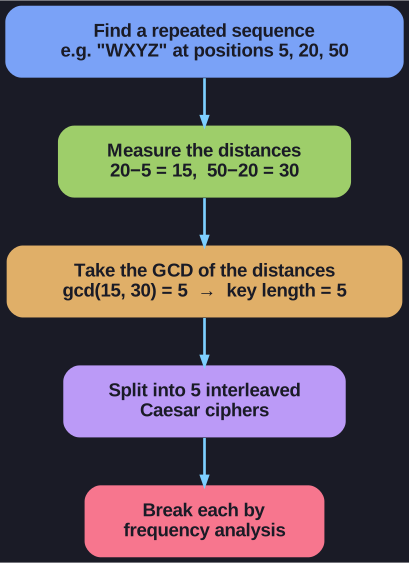
* The Kasiski test: repeated sequences to distances to GCD to key length. *
Published by Friedrich Wilhelm Kasiski in 1863, it's a statistical method that:
- Finds repeated sequences in the ciphertext (e.g., "XYZ" appears at positions 5, 20, and 50)
- Calculates distances between repetitions (15, 30, 45...)
- Finds the GCD of these distances — this reveals the keyword length
- Once the keyword length is known, the cipher reduces to multiple independent Caesar ciphers, each breakable by frequency analysis
Historical context:
- Charles Babbage independently discovered the same method earlier (around 1854) but kept it secret
- William F. Friedman refined the statistical attack in the 1920s with the index of coincidence (the "Friedman test"), which measures how "flat" the letter distribution is to estimate the keyword length
- Friedman's statistical methods were foundational to the cryptanalysis that later helped break the Enigma
Important caveat: The method requires sufficient ciphertext. With very short messages, it may not work reliably.
Go deeper:
 Kasiski examination - finding repeated ciphertext sequences and their spacings to deduce the Vigenere key length.
- Index of coincidence - Friedman's statistical companion to Kasiski for estimating key length.