What is the Millionaires' Problem, and how does Multi-Party Computation solve a variant of it?
The Millionaires' Problem (Yao, 1982): two (or more) parties want to know who is richer, without revealing how much each earns. MPC solves the "what's the average salary?" variant with a clever passing protocol — no participant learns any individual salary except their own.
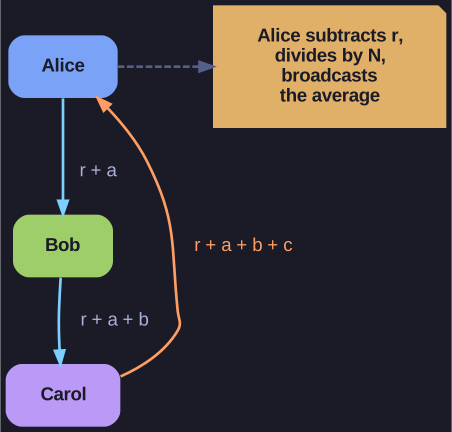
* Every value in transit is masked by Alice's secret r, so only the final average is ever revealed. *
The "secure average salary" protocol:
For N parties with private salaries a, b, c, …:
- Alice picks a random
r(large enough to hide individual salaries, kept secret). - Alice → Bob:
r + a(her salary added to the random base). - Bob → Carol:
(r + a) + b(Bob adds his own salary). - Carol → next:
(r + a + b) + c. - … each party adds their salary in turn …
- Eventually back to Alice:
r + a + b + c + … + N-th salary. - Alice subtracts
rand divides byN→ the average. - She broadcasts the average to everyone.
What each party learns:
- ✓ Everyone learns the final average.
- ✗ Nobody (except themselves) learns individual salaries — because every number in transit is offset by
r + (some prefix sum)which the next party doesn't know.
The two key security assumptions:
- Honest behaviour — every party correctly adds their value (doesn't subtract or substitute).
- No collusion — if two adjacent parties pool their knowledge, they could subtract and isolate the middle person's salary.
Real-world MPC systems relax both of these via cryptographic commitments + verifiable computation, but the textbook example illustrates the core idea: compute on shared values without revealing them.
More general MPC: allows any function f(x_1, …, x_n) to be computed where each party knows only their own input and the final output. Yao's protocol (1986) and the GMW protocol (1987) prove this is possible for every polynomial-time computable function. Modern MPC frameworks (MP-SPDZ, Sharemind, MASCOT) make this practical.
Tip: The "voting with paper slips" variant works similarly: each voter adds +1 (yes) or +0 (no) to a passed slip; only the final tally is revealed. Pen-and-paper MPC for binary voting.
Go deeper:
 Yao's Millionaires' problem (Wikipedia) — the founding MPC problem and its solution protocols.