What is the "minority problem" of DNA phenotyping? Work through the example of a trait that is 90 % accurately predicted and occurs in 5 % of a group of 1,000.
Rare traits are the most useful for a search, but the rarer the trait, the more of the people flagged are wrongly flagged. In the example, 140 people are flagged and only 45 of them really have the trait, so about two-thirds are innocent false hits.
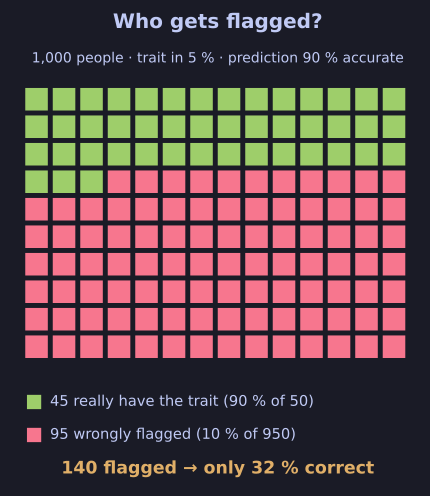
* The 140 people a 90 % accurate search flags: fewer than a third really have the trait *
A trait helps a search more if it is predicted more accurately and if it is rarer (blood group AB− at 1 % narrows a search far more than A+ at 37 %). But rarity has a cost.
The calculation (with optimistic assumptions): 1,000 people, of whom 5 % = 50 have the trait and 950 do not. The prediction is 90 % accurate:
| Really has the trait (50) | Really doesn't (950) | |
|---|---|---|
| Predicted "has the trait" | 45 correct | 95 wrongly flagged (false positives) |
| Predicted "doesn't" | 5 missed (false negatives) | 855 correct |
The search flags 45 + 95 = 140 people, and only 45 of them (about 32 %) actually have the trait. Because there are so many more people without the trait, even a 10 % error rate among them outnumbers the true hits. This is the base rate fallacy: "90 % accurate" does not mean that 90 % of the people flagged are correct.
The ethical point: when the trait marks a minority (a skin colour or origin that is rare in the population), a public search falls mostly on innocent members of that minority, which can stigmatise the whole group.
Go deeper:
 Wikipedia: Base rate fallacy — why a positive hit is less conclusive than the test's accuracy suggests.
- Wikipedia: Positive and negative predictive values — why the share of correct hits depends on how common the trait is.