What is the Münchhausen trilemma, and what are its three horns?
Any attempt to ultimately justify a claim collapses into one of three unsatisfying options: an infinite regress, a circle, or an arbitrary stopping point.
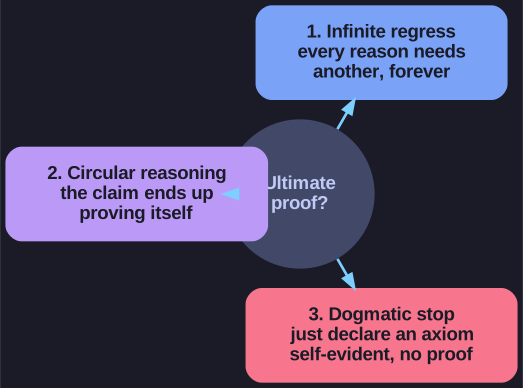
* The Münchhausen trilemma: any demand for ultimate proof ends in infinite regress, a circle, or a dogmatic stopping point. *
The Münchhausen trilemma (named after the baron who supposedly pulled himself out of a swamp by his own hair) is the claim that you can never reach a final, ultimate justification for knowledge. Every chain of "why is that justified?" ends in one of three dead ends:
- Infinite regress — every justification (y) for a claim (x) is itself a claim needing its own justification (z), and so on forever. The chain never bottoms out, so nothing is ever finally grounded.
- Circular reasoning — the justification eventually relies on the very claim it was meant to support (the conclusion props up its own premises). The reasoning runs in a circle.
- Dogmatic stop (axiom) — at some point you simply stop and declare a claim self-evident, accepting it without further justification. This is taking something on faith — a "capitulation" before the task of justifying.
The unsettling point: there is no fourth, fully satisfying option. Every foundation for knowledge has to swallow one of these three.
Tip: Regress = "it never ends," Circle = "it bites its own tail," Dogma = "it just stops." This is why total skeptics argue no belief is ever fully justified — and why most philosophies accept some dogmatic starting points.
Go deeper:
 Münchhausen trilemma — Wikipedia — the three ways every justification chain ends.
- Pyrrhonian skepticism (the regress problem) — 1000-Word Philosophy — the same trilemma as the ancient skeptics' challenge to justification.