What is the near-repeat victimisation phenomenon, and why is it so useful for predictive policing?
After a successful crime, the risk of similar crimes rises for a short time in the immediate neighbourhood, typically falling off sharply within about two weeks. This narrow pattern in space and time can be predicted by an algorithm.
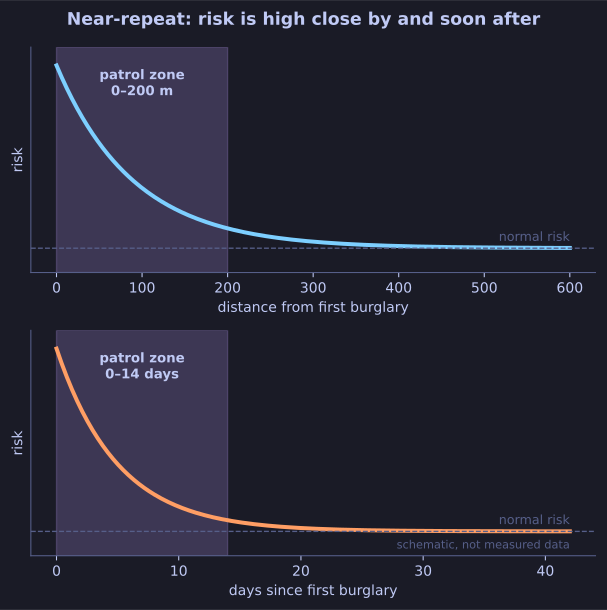
* Schematic near-repeat risk: high close by and soon after, so patrols cover a small radius for a short period *
Crime is not random but comes in clusters in space and time, set off by an initial success:
- First success: an offender breaks into house A. This shows that conditions in the area are favourable (no guardians, good loot, little surveillance).
- Spatial nearness: afterwards the risk rises for the neighbouring houses B, C and D, for two reasons:
- The offender learns: they now know the escape routes and that neighbouring houses probably have similar weaknesses.
- Signal effect: other offenders in the area notice the opportunity.
- Temporal nearness: the higher risk is temporary and drops sharply within the first two weeks after the first report.
Use in predictive policing: a reported burglary becomes the starting point for the algorithm, which calculates a radius (e.g. 200 m) and a period (e.g. 14 days) in which patrols are increased. The temporary patrol acts as the new capable guardian of the routine activity approach and removes the opportunity the first crime created. This gives micro-level, short-term warnings, where general hot spots only show areas that stay risky over months.
Go deeper:
 Wikipedia: Precobs — near-repeat burglary forecasting software, first tested in Swiss cantons.