What is the One-Time Pad (OTP), and why is it special in cryptography?
The One-Time Pad is the only cipher that is provably, information-theoretically secure — it's mathematically impossible to break, even with unlimited computing power.
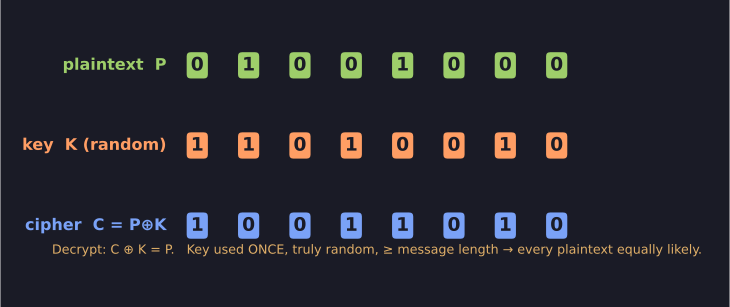
* One-time pad: ciphertext = plaintext XOR a random, single-use key. *
Invented by Gilbert Vernam in 1918 (patented as the first stream cipher). Joseph Mauborgne was the first to implement it and coined the name "One-Time Pad."
How it works:
- The key must be truly random (not pseudo-random)
- The key must be at least as long as the message
- The key must be used only once (hence "one-time")
- Encryption: XOR each bit of plaintext with the corresponding key bit
Why it's unbreakable: Given any ciphertext, every possible plaintext of the same length is equally likely. An attacker gains zero information.
Why it's rarely used in practice:
- Key distribution: you need to securely share a key as long as every message
- Key storage: enormous amounts of truly random key material
- One-time use: any reuse completely destroys security
Historical use: The Washington-Moscow hotline ("red phone") during the Cold War reportedly used OTPs for guaranteed security on the most sensitive communications.
Go deeper:
 One-time pad - the Vernam XOR cipher and Shannon's proof of perfect secrecy.
 The one-time pad (Khan Academy) - a short animated walkthrough of why the OTP is unbreakable.