Quiz Entry - updated: 2026.07.30
What is the overall protocol-level sequence of a 2G phone from power-on until it can use mobile data?
Network graph awareness → network selection (RF scan, sync, BCCH decode) → cell selection → LOCATION UPDATE (registration) → GPRS LOCATION UPDATE / attach (data registration) → PDP CONTEXT (tunnel to the internet).
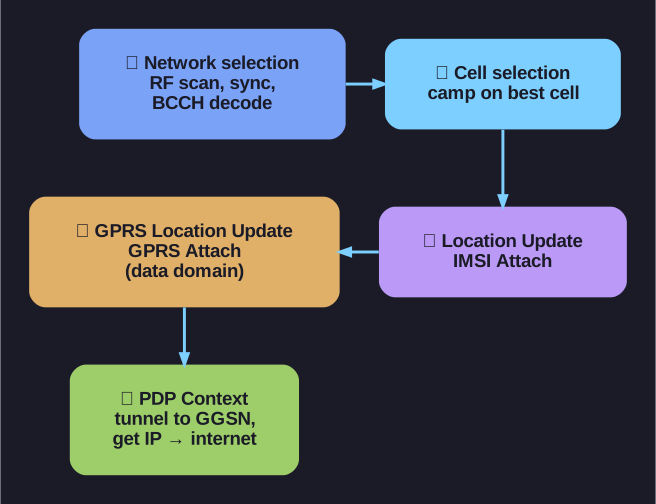
* The full 2G chain from power-on to the internet. *
The complete chain, in order:
- The classic GSM (2G) network is the playing field: MS ↔ BTS ↔ BSC ↔ MSC, with HLR/VLR/AUC behind it
- Network Selection: RF power scan → frequency + sync burst detection → BCCH decode (learn MCC/MNC/Cell-ID)
- Cell selection state machine — the phone settles ("camps") on the best suitable cell
- LOCATION UPDATE — registration with the network (IMSI Attach at power-on)
- GSM Control Plane protocol stack carries all of this signaling
- GPRS LOCATION UPDATE / GPRS Attach — separate registration for the data domain (toward the SGSN)
- PDP CONTEXT activation — the tunnel to the GGSN; the phone gets an IP address and reaches the internet
- The same concepts carry over to UMTS with new names on the radio side
Why learn the 2G version? Because it's the simplest complete instance of the pattern — and every later generation (UMTS, LTE, 5G) is a refinement of exactly this sequence: find network → authenticate & register → establish session. Master it once in 2G and the LTE attach procedure reads like a familiar story with renamed characters.
Go deeper:
 Harald Welte — What happens on a protocol level when I switch on my phone? (CCC) — a step-by-step live walkthrough of exactly this power-on → register → data sequence in real protocol messages.
 Network switching subsystem (Wikipedia) — reference for the MSC / HLR / VLR / AUC core elements behind the MS↔BTS↔BSC↔MSC playing field.