What is the Panopticon, and how does Foucault use it to explain modern power?
A prison designed so inmates can always be watched but never know when — Foucault's image for power that works through internalised, permanent surveillance rather than force.
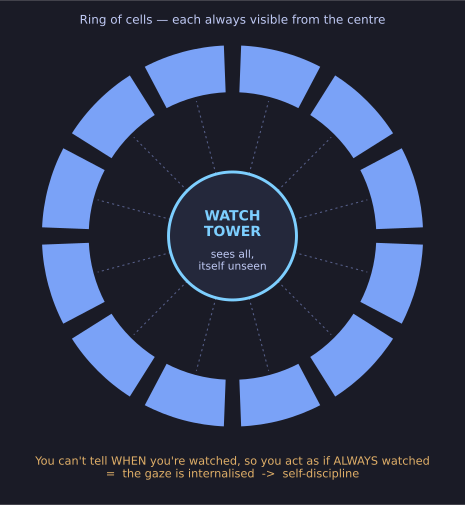
* Bentham's design: one tower can watch any cell but is never seen back, so inmates self-discipline — Foucault's model of internalised modern power. *
Jeremy Bentham's Panopticon (1791) is a circular prison with a central watchtower: any cell can be observed at any moment, but the prisoners cannot tell whether they are being watched right now. Because they might always be observed, they behave as if they always are.
Michel Foucault (Discipline and Punish, 1975) generalised this into a theory of modern power. Power, he argued, no longer operates mainly through violence or punishment, but through invisible, permanent surveillance: people internalise the controlling gaze and discipline themselves. Budelacci's point for the digital age: pervasive data collection recreates the Panopticon at scale — we self-censor and self-regulate because we sense we could always be watched, which is why a measure of private free space is a precondition for both physical and psychological wellbeing.
Go deeper:
 Wikipedia — Panopticon — Bentham's design and Foucault's reinterpretation.
- Wikipedia — Discipline and Punish — Foucault's book generalising the panopticon into a theory of modern disciplinary power.