Quiz Entry - updated: 2026.07.30
What is the privacy/utility trade-off controlled by the parameter k?
Larger k means stronger anonymity but greater information loss — you buy privacy with utility.
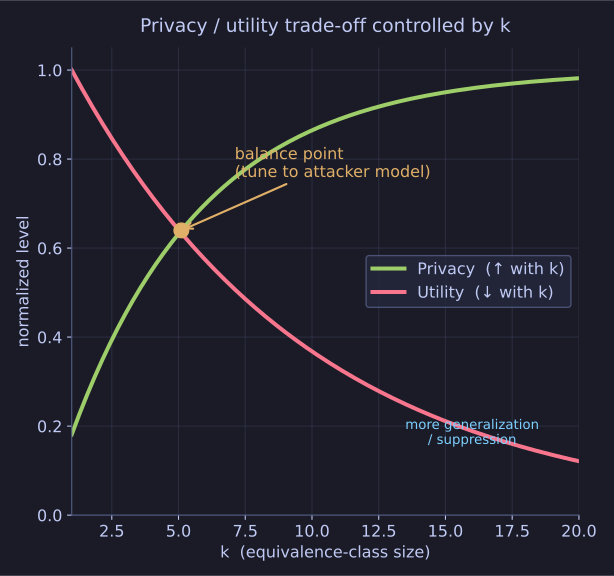
* As k grows, privacy rises and utility falls — tune k to the attacker model. *
Raising k forces bigger equivalence classes, which requires more aggressive generalization or suppression to herd records together. So:
- k ↑ → privacy ↑ (bigger crowd, harder to single out anyone)
- k ↑ → utility ↓ (coarser data, more detail destroyed)
There's no universally "correct" k — it depends on how sensitive the data is and how strong the attacker is. A public-release medical dataset might demand a large k; an internal low-risk analytics table might tolerate a small one.
Tip: Tune k against your attacker model, not by habit. The right k is the smallest one that defeats the threat you actually face.
Go deeper:
 k-anonymity (Wikipedia) — larger k means more generalization and information loss.