What is the protection-utility trade-off in data anonymization?
The more data you make available for analysis (utility), the higher the risk of re-identification — even with anonymized datasets. Finding a "good solution" means balancing both.
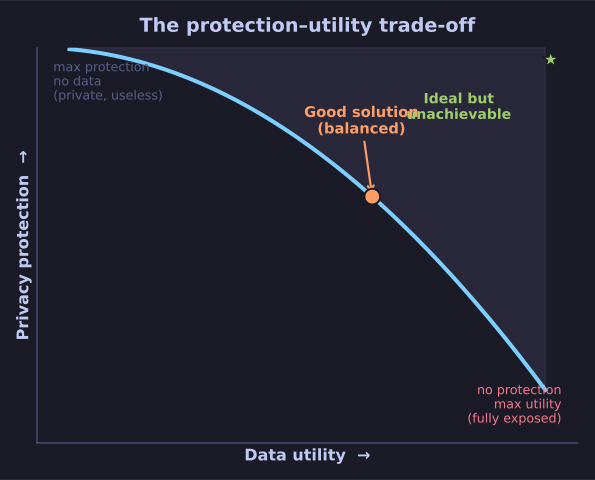
* The protection–utility frontier — every gain in utility costs some protection; the ideal top-right corner is unreachable. *
The trade-off visualized as a curve with four corners:
- Top-left: Maximum protection, no data — perfectly private but completely useless
- Top-right: Maximum protection, maximum utility — the ideal but unachievable goal
- Bottom-left: No protection, no data — useless and unprotected
- Bottom-right: No protection, maximum utility — all data exposed, no privacy
The optimal solution lies on the curve between these extremes — providing enough data utility for meaningful analysis while maintaining sufficient protection against re-identification.
Practical implications:
- More generalization (ZIP 60126 → 601*) increases protection but reduces analytical value
- Less suppression preserves utility but increases re-identification risk
- The "right" balance depends on the sensitivity of the data and the intended use case
- Even with "good" anonymization, the risk of re-identification through external data sources must always be considered
Key takeaway: There is no free lunch in anonymization — every gain in data utility comes at some cost to privacy protection, and vice versa.
Go deeper:
 Data anonymization (Wikipedia) — anonymization techniques and the utility-vs-privacy balance they force.