Quiz Entry - updated: 2026.10.15
What is the taxonomy of hash functions in cryptography?
Hash functions split into keyed (MAC, HMAC) and unkeyed; unkeyed further splits into cryptographically secure (MDC) and non-secure (checksums, CRC).
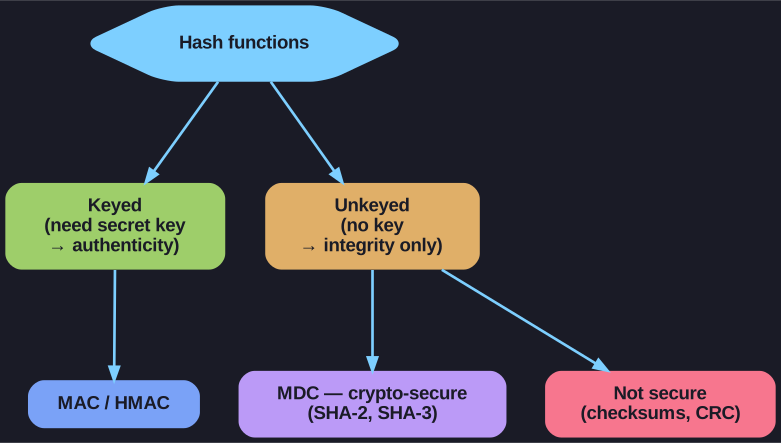
* Keyed hashes (MAC/HMAC) give authenticity; unkeyed split into secure MDCs and non-secure checksums/CRC. *
Hash Functions
├── Keyed
│   ├── MAC (Message Authentication Code)
│   └── HMAC (Hash-based MAC)
└── Unkeyed
    ├── Cryptographically secure → MDC (Manipulation Detection Code)
    └── NOT cryptographically secure
        ├── Checksums
        └── CRC (Cyclic Redundancy Check)
Key distinction:
- Keyed hash functions (MAC/HMAC): Require a secret key → provide authenticity (who sent it) + integrity
- Unkeyed hash functions (MDC): No key needed → provide only integrity detection (anyone can compute the hash)
MDC stands for Manipulation Detection Code — it detects if data was changed, but can't tell you who changed it. For that, you need a keyed hash (MAC) or a digital signature.
Go deeper:
 Cryptographic hash function — the properties that make a hash cryptographically secure.
 SHA: Secure Hashing Algorithm (Computerphile) — a visual walk through how SHA digests are built.