What is the TimeToTrigger timer in UMTS handover, and why is a hysteresis margin alone not enough?
A handover event (a cell crossing into or out of the Reporting Range) must hold continuously for a TimeToTrigger period before the Active Set is actually changed — the timer filters out brief signal spikes that the level-based hysteresis margin alone would still let through.
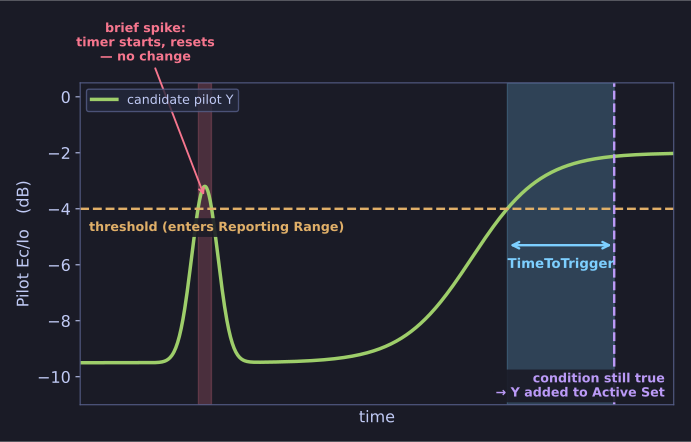
* A spike resets the timer, no change; a sustained crossing outlives the TimeToTrigger and the cell is added. *
Two complementary filters guard the Active Set (the set of cells the phone is connected to):
| Filter | Domain | Question it asks |
|---|---|---|
| Hysteresis margin (±H) | Signal level | Is the candidate convincingly better/worse, not just marginally? |
| TimeToTrigger (TTT) | Time | Has the condition held long enough to be real, not a blip? |
Why both are needed: radio signals fluctuate fast — a passing truck or a reflection around a corner can push a pilot signal across any threshold for a few hundred milliseconds. A margin only asks how far the signal moved, so a short, large spike still clears it. The TimeToTrigger starts counting the moment a pilot crosses the threshold, and the radio-link addition or removal fires only if the condition still holds when the timer expires — a transient spike resets without consequence.
In the standard measurement picture: as a mobile moves from NodeB X toward NodeB Y, a timer starts when Y's pilot enters the Reporting Range; only after it runs out does Y join the Active Set, and the same timer logic later governs X's removal.
Tip: Hysteresis asks "is it enough better?", TimeToTrigger asks "has it been better long enough?" — level filter plus time filter. LTE kept the exact same pattern: its A3 handover event uses a hysteresis parameter and a timeToTrigger parameter.
Go deeper:
 Handover (Wikipedia) — the measurement-based handover decision process these trigger conditions feed.