What is the Vigenère cipher, and why was it a major improvement over the Caesar cipher?
The Vigenère cipher is a polyalphabetic substitution cipher that uses a keyword to shift each letter by a different amount, defeating simple frequency analysis.
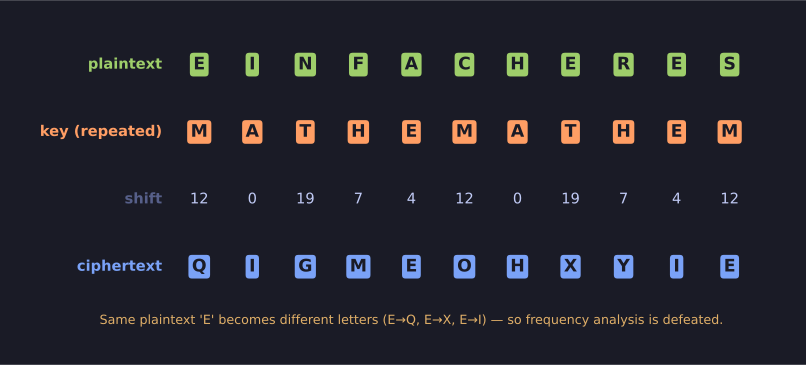
* Vigenere: a keyword gives each position its own shift. *
Invented by Blaise de Vigenère in 1586 (building on ideas from the Benedictine monk Johannes Trithemius, 1462-1516), it was considered unbreakable for nearly 300 years.
How it works:
- Choose a keyword (e.g., "MATHE")
- Repeat the keyword to match the plaintext length
- Each letter of the keyword determines the shift for the corresponding plaintext letter
Worked example (key = MATHE):
| Plaintext | e | i | n | f | a | c | h |
|---|---|---|---|---|---|---|---|
| Key | M | A | T | H | E | M | A |
| Shift | 12 | 0 | 19 | 7 | 4 | 12 | 0 |
| Ciphertext | Q | I | G | M | E | O | H |
Why it defeats frequency analysis: The same plaintext letter maps to different ciphertext letters depending on its position. For example, encrypting "einfacheres" with key "MATHE", the letter 'e' encrypts to Q, I, and other letters at different positions.
Tip: Think of Vigenère as "multiple Caesar ciphers layered on top of each other" — one for each letter of the keyword. You can explore this interactively at cryptool.de.
Go deeper:
 Vigenere cipher - polyalphabetic substitution via a keyword; history, mechanism, and the tabula recta.
 cryptii Vigenere cipher - encrypt/decrypt with a keyword and watch the shifting alphabets.