What is traffic management and Quality of Service (QoS) in a small network?
QoS configures routers/switches to prioritize real-time traffic (voice/video) over other data using priority queues — the high-priority queue is always emptied first.
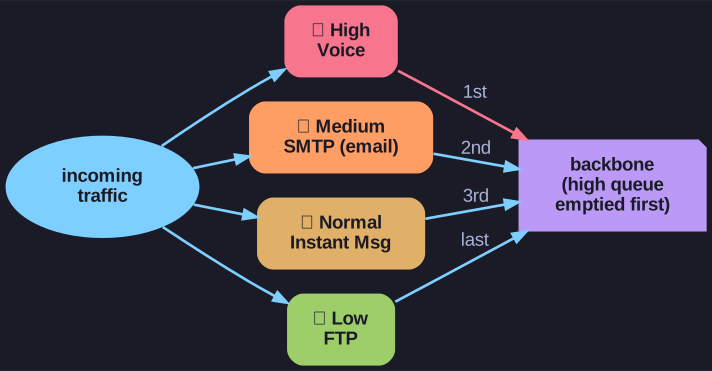
* Traffic is sorted into priority queues; the high-priority queue (voice) is always emptied first. *
The problem QoS solves is that a link has finite capacity, and when it gets busy some packets must wait. Without prioritisation every packet waits its turn equally — fine for a file download, fatal for a phone call, because voice and video are real-time: a packet that arrives late is useless and the listener hears a gap or stutter. Priority queuing fixes this by sorting outbound traffic into separate queues (typically four) and emptying the high-priority queue first before touching the lower ones, so latency-sensitive voice jumps ahead of email and file transfers. A bulk FTP transfer barely notices the few milliseconds it loses; a voice call would have been ruined by that same delay. That asymmetry — some traffic tolerates delay, some doesn't — is the whole reason QoS exists.
Traffic Management:
Goal: The goal for good network design is to enhance the productivity of employees and minimize network downtime.
Quality of Service (QoS):
Routers and switches in a small network should be configured to support real-time traffic (such as voice and video) appropriately relative to other data traffic.
Priority Queuing:
- Network devices use priority queuing with typically four queues
- The high-priority queue is always emptied first
- Traffic is sent to the backbone in order of priority
Traffic Priority Levels (high to low):
| Priority | Traffic Type |
|---|---|
| High | Voice |
| Medium | SMTP (email) |
| Normal | Instant Messaging |
| Low | FTP |
Key insight: Without QoS, all traffic is treated equally, which can cause delays in time-sensitive applications like voice and video.
Go deeper:
 Wikipedia — Quality of service — queuing strategies, traffic prioritization, and why voice/video need it most.