Quiz Entry - updated: 2026.10.26
What key principle classifies asymmetric algorithms by whether their one-way function has a trapdoor?
"Some asymmetric algorithms rely on one-way functions WITH trapdoor, others on one-way functions WITHOUT trapdoor."
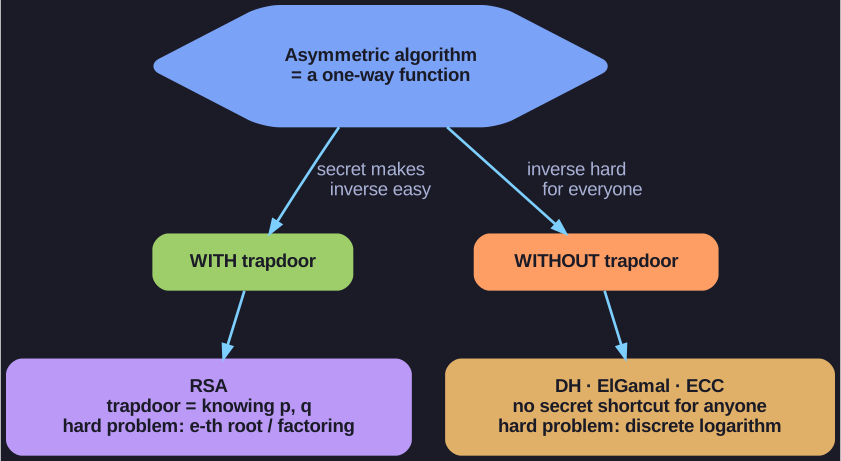
* With a trapdoor, a secret shortcut makes the inverse easy for its owner; without one, the inverse is hard for everyone. *
This fundamental distinction divides all public-key cryptography:
| Type | Trapdoor? | Example | Hard Problem |
|---|---|---|---|
| RSA | Yes — knowing $p, q$ | Encryption + Signatures | $e$-th root mod $N$ (factoring) |
| Diffie-Hellman | No | Key exchange only | Discrete logarithm mod $p$ |
| ElGamal | No | Encryption + Signatures | Discrete logarithm mod $p$ |
| ECC | No | Encryption + Signatures | Discrete logarithm on curves |
With trapdoor means: there exists a secret (the factorization $N = p \cdot q$) that makes the inverse computation easy. Without it, the inverse is infeasible.
Without trapdoor means: the inverse is hard for everyone — there is no shortcut. Security relies on the mathematical structure, not a secret shortcut.
Go deeper:
 Trapdoor function (Wikipedia) — the precise definition of "easy one way, easy back only with a secret".
- Public-key cryptography (Wikipedia) — the whole family this distinction organises.