What makes building and running a Security Operations Center succeed, and what are the biggest hurdles in practice?
Success comes from a clear strategy, effective technology and partners, one holistic owner, and continuous tuning; the hurdles are mostly cost, scarce staff, heavy documentation and alert-noise — not the technology itself.
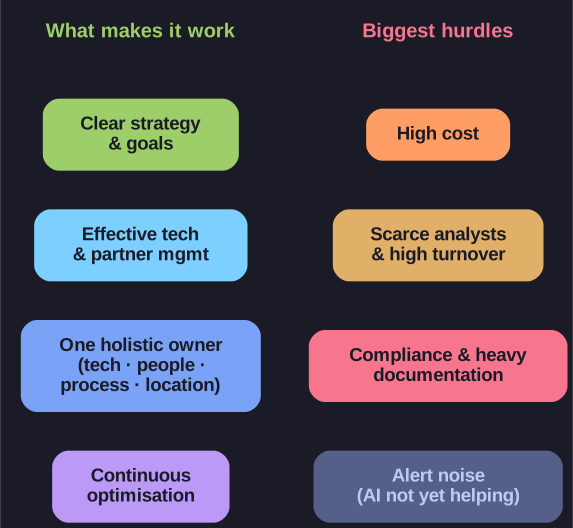
* What makes a SOC work versus the biggest hurdles in practice. *
Running a SOC is an organisational challenge as much as a technical one — the same people / process / technology balance as the golden triangle, plus the location that houses it.
What makes it work:
- A clear strategy and goals — a SOC with no defined mission drowns in alerts without knowing what it is actually protecting.
- Effective technology and good partner management — the tooling (SIEM, detection platforms) and the vendors or managed-service providers behind it have to genuinely deliver.
- A holistic approach — ideally one accountable owner across all four dimensions (technology, people, processes and the physical/virtual location) so nothing falls between silos.
- Continuous optimisation — detection rules and processes decay as the environment and threats change; a SOC that stops tuning slowly stops working.
The biggest hurdles:
- High cost plus a shortage of skilled analysts and high turnover — the scarcest resource is trained people, who are expensive and hard to keep.
- Compliance demands (e.g. ISO 27001), quality management, and heavy documentation of responsibilities, processes and controls.
- Fast-moving technology and a high false-positive rate — and, bluntly, "AI" is still largely a buzzword here: it does not yet meaningfully cut the flood of false positives an analyst must wade through.
Tip: Almost every hurdle is about people, money and process discipline, not about buying a better box — the golden triangle again: tools alone never make a working SOC.