What organizations establish UTP standards and what are the cable categories?
The cabling categories (Cat 3–7) are defined by TIA/EIA (ANSI/TIA-568) and ISO/IEC — not by IEEE. IEEE defines the Ethernet signalling standards (802.3) that run over those cables, which is a different thing.
It is easy to mix up two different sets of standards bodies here, so keep them straight:
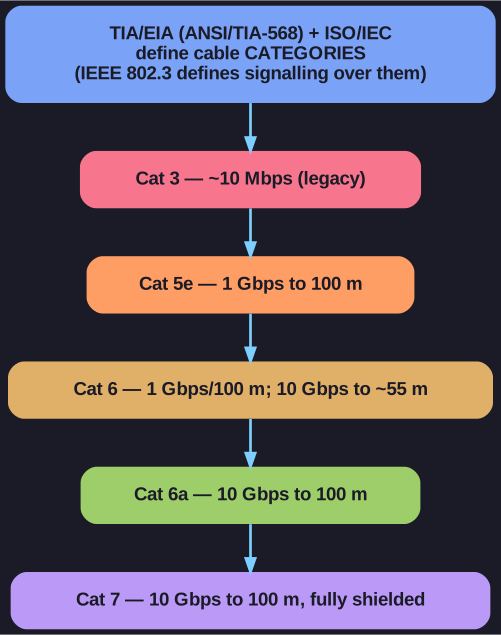
* TIA/EIA and ISO/IEC own the cable categories (Cat 3 → Cat 7); IEEE 802.3 owns the signalling that runs over them. *
- TIA/EIA (the ANSI/TIA-568 standard), together with ISO/IEC, defines the physical cabling itself — cable types, the performance categories, maximum lengths, connectors, termination, and testing methods. The "Cat 5e / Cat 6 / Cat 7" you read on a cable jacket are their categories.
- IEEE does not rate the cable categories. IEEE defines the Ethernet signalling standards — the 802.3 family (1000BASE-T, 10GBASE-T, etc.) — i.e. how data is electrically sent over the cabling. A given Ethernet standard then specifies which cable category it needs.
Cabling categories (TIA/EIA & ISO/IEC):
| Category | Practical speed / reach |
|---|---|
| Category 3 | Legacy (~10 Mbps; old voice/Ethernet) |
| Category 5e | ~1 Gbps to 100 m |
| Category 6 | 1 Gbps to 100 m; 10 Gbps only to ~55 m |
| Category 6a | 10 Gbps to 100 m |
| Category 7 | 10 Gbps to 100 m, fully shielded (S/FTP) |
Note: the course slide attributes the categories to IEEE, but that is an oversimplification — IEEE owns the signalling (802.3), while TIA/EIA and ISO/IEC own the cabling categories.
Go deeper:
-
 ANSI/TIA-568 — Wikipedia — the cabling standard that actually defines the categories (Cat 5e/6/6a/8) and T568A/B.
 -
Ethernet cable categories Cat 5/6/7/8 explained — Electronics Notes — what each category's speed, frequency, and shielding mean in practice.
-
 Category 6 cable — Wikipedia — a worked example of one category's specification and reach limits.