What privacy-preserving techniques go "beyond" traditional generalization-based anonymization?
Homomorphic encryption, federated learning, blockchain-based sharing, and synthetic data — each tackles privacy without simply coarsening a released table.
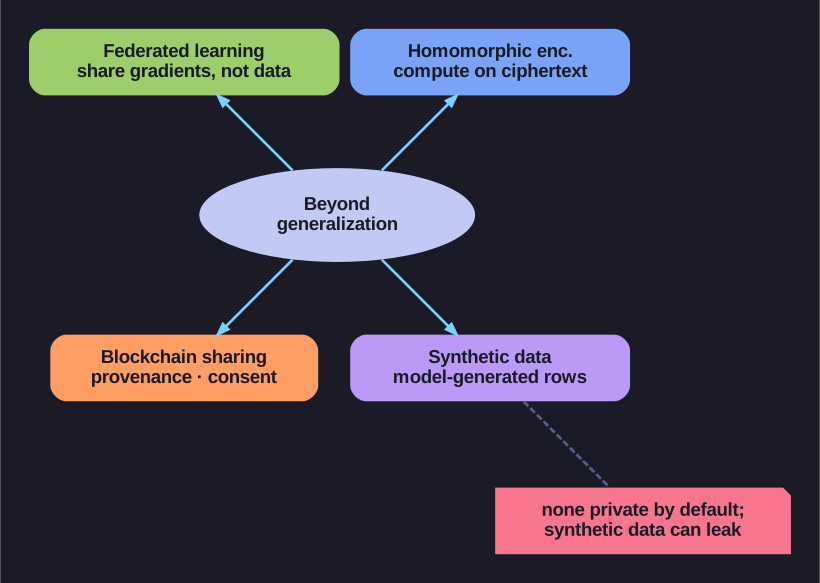
* Techniques beyond generalization — none private by default; synthetic data needs validation. *
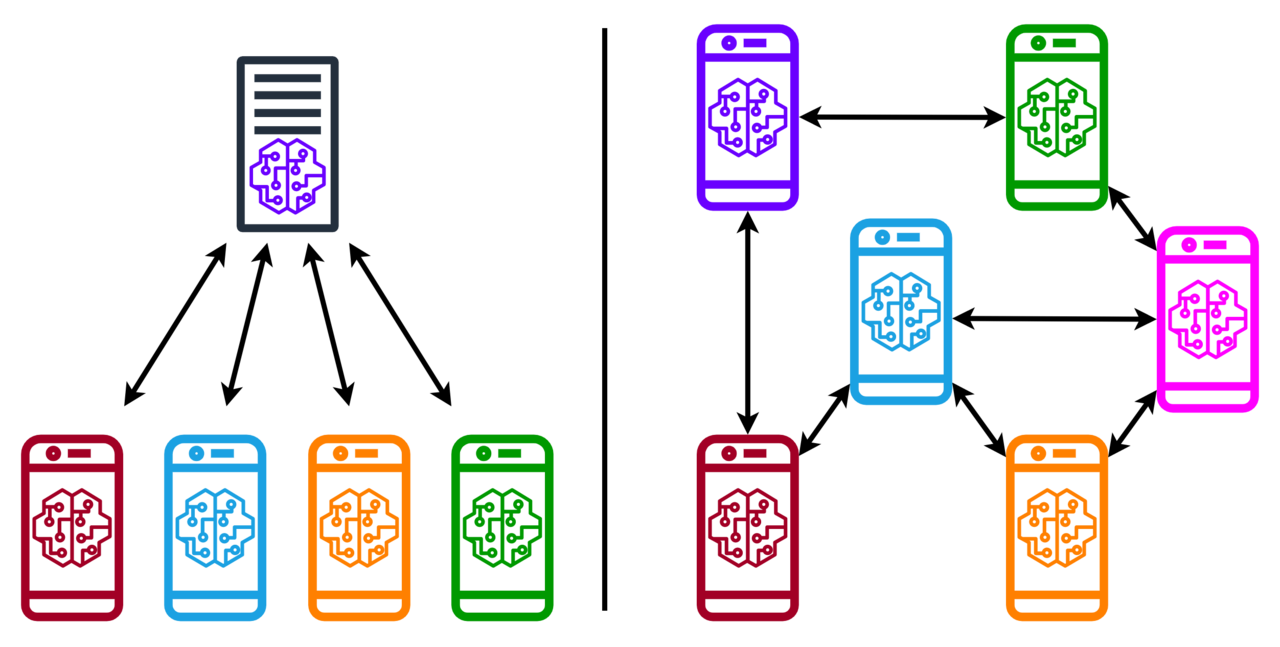
* Centralized vs decentralized federated learning. — MarcT0K, CC BY-SA 4.0, via Wikimedia Commons. *
Classic anonymization (k-anonymity and friends) works by coarsening a table before you release it — you accept some utility loss to make individuals blend in. The techniques below take a different angle: instead of degrading a released dataset, they change where the computation happens or what data is exposed at all, so the raw records never need to leave a trusted boundary:
- Homomorphic encryption — compute directly on encrypted data without ever decrypting it, so the processor sees only ciphertext. As of the 2025-2026 source window it was still computationally expensive but maturing rapidly; relevant for cloud compute on sensitive datasets.
- Federated learning — train models on data that stays decentralized on user devices or partner servers; only gradients or model deltas are sent to the aggregator, never the raw records. It's often combined with differential privacy because gradients alone can still leak training examples.
- Blockchain & decentralized sharing — tamper-resistant ledgers for data provenance, consent tracking, and auditability without a single point of trust. Still experimental at scale, and a ledger protects integrity, not confidentiality.
- Synthetic data & generative models — model-generated records that preserve the statistical properties of real data so analysts can work on fakes. The catch: privacy is NOT automatic — a generative model can memorize and leak membership or reveal outliers, so synthetic data must be validated, not trusted by default.
The recurring theme: each tool removes a different exposure (the released table, the centralized copy, the trust anchor, the real records), but none is "private by default" — every one needs careful design.
Tip: Remember them by what they avoid releasing: homomorphic encryption avoids exposing plaintext, federated learning avoids centralizing the data, blockchain avoids a single trusted party, synthetic data avoids using real rows. Synthetic data is the one most often mistaken for "automatically safe" — it isn't.
Go deeper:
 Homomorphic encryption (Wikipedia) — compute on encrypted data without decrypting.
- Federated learning (Wikipedia) — train on decentralized data, share only model updates.
- Synthetic data (Wikipedia) — generative records (privacy not automatic).