What problem did Diffie-Hellman key exchange solve in 1976, and what is the color analogy for the protocol?
It let two parties agree on a shared secret key over a completely public channel, without ever having met before. The colour analogy: each side mixes a public colour with their secret colour, exchanges the mix, and re-mixes with their own secret — both end up with the same final blend.
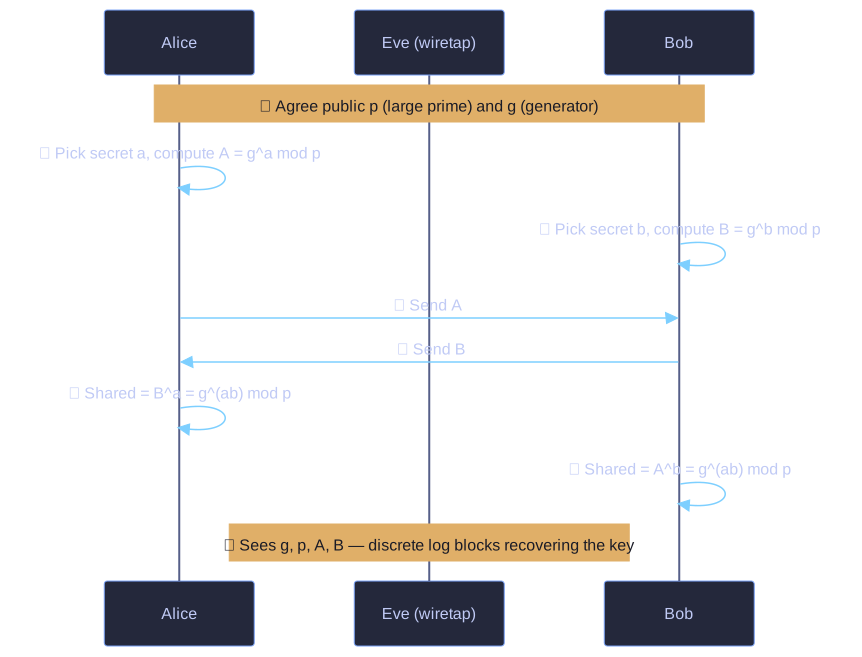
* Diffie-Hellman — both sides derive g^(ab) mod p over a public channel; the eavesdropper hits the discrete-log wall. *
Before DH (1976): symmetric crypto required a pre-shared key. Distributing keys to billions of internet peers was impossible without a private courier. The DH key exchange was the original breakthrough that made modern internet security possible.
Color analogy:
- Alice and Bob agree on a public colour (yellow).
- Each picks a secret colour (Alice orange, Bob teal).
- Each mixes public + secret and sends the result publicly.
- Each re-mixes the received mixture with their own secret → both get the same final brown.
Even with full visibility of yellow, orange-yellow, and teal-yellow, an attacker can't "un-mix" to recover orange or teal — that's the hard part. Re-mixing without one of the secrets is infeasible.
Mathematical version:
| Step | Alice | Bob |
|---|---|---|
| Public | p (large prime), g (generator) |
same |
| Private | picks a ∈ {2, …, p−2} |
picks b |
| Compute | A = g^a mod p |
B = g^b mod p |
| Send | sends A |
sends B |
| Shared key | B^a = g^(ab) mod p |
A^b = g^(ab) mod p |
Both end up with g^(ab) mod p. Eve sees g, p, A, B — to compute g^(ab) she'd have to solve the discrete log problem (recover a from A), which is infeasible for large p.
Historical note: declassified 1997 documents revealed Cocks (1973) at GCHQ had invented the same idea three years earlier — but as classified work it had no impact on industry. Public credit goes to Diffie, Hellman, and Merkle.
Tip: A small worked example uses p=29, g=2, a=5, b=4 and produces shared key 23. Try it yourself — 2^5 mod 29 = 3, 2^4 mod 29 = 16, 16^5 mod 29 = 23 = 3^4 mod 29.
Go deeper:
 Diffie–Hellman key exchange (Wikipedia) — canonical reference, including the exact paint-mixing colour analogy.
 Secret Key Exchange (Diffie-Hellman) — Computerphile — Mike Pound's clear video walkthrough of the shared-secret intuition.