Quiz Entry - updated: 2026.07.30
What three special cases must a compiler handle when translating a switch statement?
Multiple labels mapping to one block, fall-through between cases, and missing case values that route to default.
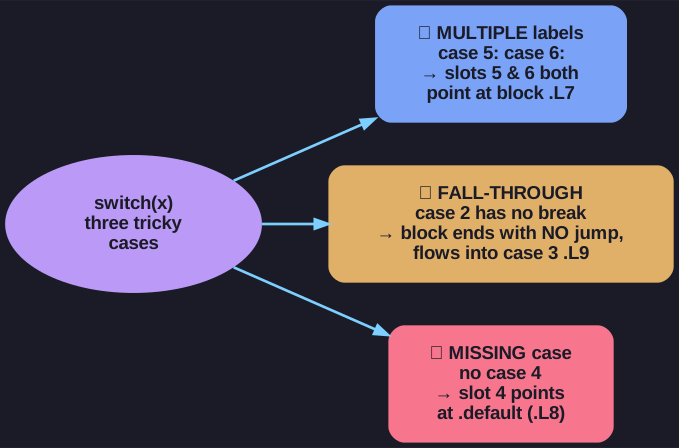
* The three tricky switch cases and how the compiler handles each. *
A switch looks simple in C but hides three irregularities the code generator must respect. Take this example:
switch (x) {
    case 1: w = y*z; break;
    case 2: w = y/z;          // no break -> falls through!
    case 3: w += z;  break;
    case 5:
    case 6: w -= z;  break;    // two labels, one body
    default: w = 2;
}
| Challenge | How it's handled |
|---|---|
| Multiple labels (5 & 6) | Both jump-table slots point at the same code block |
| Fall-through (2 → 3) | Case 2's block simply doesn't end in a jump, so control flows into case 3 |
| Missing case (4) | That jump-table slot points at the default block |
Why this is interesting: these three behaviors are exactly what makes switch more than syntactic sugar for an if-chain — a jump table elegantly handles holes and duplicate tags, and ordinary code-sequencing handles fall-through "for free."
Go deeper:
 Switch statement (Wikipedia) — the switch statement, including fall-through.
- Branch table / jump table (Wikipedia) — the jump table that handles holes and duplicate tags.